The Ancient of Days
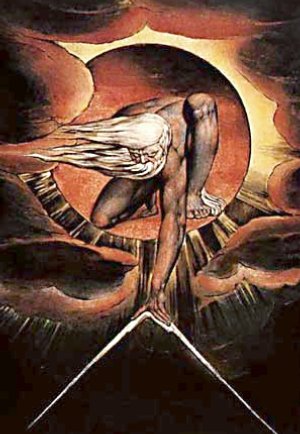
No, this post is not about Adam, pre-Adamites, or the origin of the Nodites. Nor is it about Mormonism except perhaps in a very tangential and attenuated way. I've been asked to explain the image in my profile. It is a painting by an English poet, painter, printer, engraver, and some say, prophet, William Blake. The painting is entitled "The Acnient of Days" and represents a creator figure, framing the earth with a compass.
Recognized as one of the "big six" canonical romantic poets (Blake, Coleridge, Wordsworth, Byron, Shelley, Keats), Blake is one of the most perplexing figures in Romanticism. He is a poet, like the others, but he is more than a poet because he often created his words with visual art that intertwines with its meaning. And he is more than an artist because he was also a creator of mythology. Volumes could be written (and have) about him, so I won't attempt to make a complete statement about the man.
I will say only that he was intensely religious, but hated the established church. He often had visions of heavenly visitors, beleived that he conversed with Old Testament prophets, and when he saw a sunset he claimed to behold "an innumerable company of the heavenly host crying, “Holy, holy, holy is the Lord God Almighty." He was also an intense beleiver in equality, humanity, charity, and love, often speaking against slavery and expounding on the wrongness of racism.
Many of his poems (I don't pretend to understand what are called his propetic books) appear deceptively simple. With a nursery-rhyme rhythm you might think you're reading kids stuff, but the themes are complex and sometimes dark, and he packs a lot of meaning into a few simple lines. Consider this indictment of London's booming prostitution industry at the turn of the century and its effect on young poor women:
O Rose, thou art sick!
The Invisible worm,
That flies in the night,
In the howling storm,
Has found out thy bed
Of Crimson joy;
And his dark secret love
Does thy life destroy.
Blake is one of my favorite writers. His art is also high on my list. One of his most underappreciated works is the set of illustrations he did for the book of Job. His visionary and mystical esctasies lead many to conclude that he was insane. For example, he once looked up and saw "God's head upon the window" and launched into a screaming fit. Indeed, as you read his life, it is hard to escape this conclusion. Even so, he ought not to be dismissed. Wordsworth said of him:
There was no doubt that this poor man was mad, but there is something in the madness of this man which interests me more than the sanity of Lord Byron and Walter Scott
Trivia:
1) What band got their name from a Blake writing?
2) Which U2 song is taken from a Blake poem?
3) Name one novelist and one additional artist who identify Blake as an influence.


