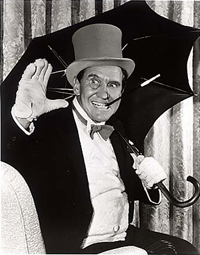
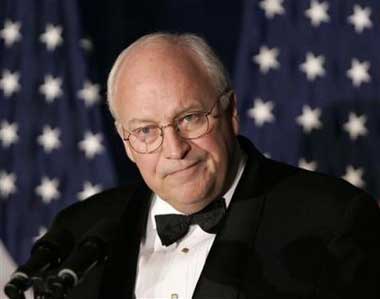
Yes, the Cheney-The Penguin comparisons have grown so commonplace as to almost be tiresome. On the other hand, perhaps the longevity of the comparison is an indication of the fact that it rings so true. If its a tiresome joke, its only because it's so easy. In a Penguin look-alike contest, Cheney would probably beat out FDR even sans cigarette holder. But it is a pretty close race:
As many of you are aware, Old Dick himself will be speaking at commencement at Brigham Young University this Thursday at 4:00 PM Mountain Time. You can watch it
here by clicking on "tune in now". After all that's been said about Cheney at BYU, Eric Snider's
piece is the most insightful.
My take on it: BYU's decision accept Cheney's self-invite to speak isn't the end of civilization as we know it, but it probably was ill-advised. Were BYU an average run-of-the-mill independent private school, there wouldn't really be anything wrong with it beyond the bare fact that Cheney is unpopular and annoying. But BYU is not an average private school; it is the flagship educational institution of a major religious organization with a declared commitment to political neutrality. I don't think BYU in the abstract should refrain from inviting political officials, even controversial ones, to speak on campus. But the question cannot be considered in the abstract.
1. This is not just a speech, this is commencement. Commencement ought to be apolitical. Anyone who thinks that Cheney will not use commencement as a political platform is fooling himself.
2. Commencement gives the impression that the University endorses the speaker. Speaking at a forum is speaking to the University community, but speaking at commencement is in most people's minds, speaking to the graduates on behalf of the University.
3. This comes at a time when only one other campus has allowed Cheney to speak at commencement, and when the Administration's approval ratings are beyond abysmal. In this environment,

accepting Cheney's self-invite could easily be construed, right or wrong, as some kind of implicit endorsement.
4. BYU, despite its efforts to be even-handed, has a pattern of inviting more conservative speakers to campus. Inviting Cheney only reinforces this pattern and in doing so, undermines the Church's effort to be politically neutral.
It has been suggested that inviting Tom Lantos to speak a few years ago balances inviting Cheney. The comparison is flawed for several reasons. First, Lantos' wife is a Mormon; it is not unusual that BYU would invite someone with ties to the LDS community, regardless of politics. (The same is true about Harry Reid, who spoke at BYU Law commencement a few years ago). Second, Lantos himself is a holocaust survivor. Someone with that kind of experience is a good speaker to have regardless of politics. Third, Lantos is only one of hundreds of members of Congress. Cheney, on the other hand, is the number two of a co-equal branch of government. While it is true that democrats have spoken on campus, to get one comparable to Cheney in national profile and party stature you have to go all the way back to Bobby Kennedy's
speech at the Smith Fieldhouse in 1968; and he didn't even speak at commencement. (On the other hand, that was during the Wilkinson years; the fact that he even got on campus is kind of a big deal).
I think part of the issue here is that the BYU administration sees the world through Provo-colored lenses. In that worldview, there's nothing partisan or that even appears partisan about BYU's choice of speakers. But BYU is not a regional school anymore, it is a national school, and it represents an international church. From a national or international perspective, BYU's choice of speakers tends to lean to the right.
Let me be clear: I don't think BYU or any other school has a legal or an ethical obligation per se to be even-handed in its speakers. But if the First Presidency is going to continue to
insist on partisan neutrality, any appearance of a lack of neutrality in BYU is damaging. This is even more so now that media attention is shifting towards Mormons for a variety of reasons (Romney, the PBS documentary, the Mountain Meadows Massacre movie, Kyle Sampson, etc.).
However, the fact that BYU has invited Cheney to speak at commencement and the backlash against that decision have put the administration on their toes. This could mean that BYU will make a greater effort to invite political figures from both sides. At least one of my old profs has said that he will donate nothing to the Alumni organization until BYU invites the anti-Cheney to campus.
Further Reading:Provo Daily Herald: "Opponents Organize Against Cheney Visit"CNN.com: "Students peacefully protest Cheney's upcoming appearance at BYU"A blog with pictures of the April 4th demonstration
 The other night, on the way to Ben & Jerry's for some quality overpriced ice cream, I found myself missing some of my favorite Provo haunts. One of the greatest things about Provo is that eating out is cheap. That memory inspired these lists: