Showing posts with label Desultory Musings. Show all posts

Tuesday, October 9, 2007

Bullied by Big Milk: Why I oppose Kirkland's new jug


How could this happen?

The other day we went to Costco to pick up some essentials. We walked past the milk jugs like four times looking for the milk. This is because milk at Costco no longer looks like milk. Apparently, Kirkland (Costco store brand) has redesigned their milk jugs.

I can only assume that it is supposed to increase efficiency. The new shape has a slightly smaller footprint, but more importantly, a flat top so you can stack them more easily on a pallet.

The good part is that it fits a little more easily in the side of the refrigerator. The bad part is that when it's full, it's a little top heavy. And the lid lacks the funnel shaped neck of the old bottles. The lid is also inexplicably bigger. I can't figure why, but I'm sure some physics-savvy soul could explain the efficiency-increasing reason for a bigger lid. The result of all this (top-heaviness, no neck, big opening) is an unwieldy pour. It reminds me of trying to pour from a paint can without the benefit of the little wire handle.

Top-heavy, big mouth, no neck, flat-top: I will call Kirkland's new jug the Biff. Aside from the aforementioned pouring issues, I have other problems with the Biff. The Biff is a sqaure, meat-headed container. It lacks the ample base, and the friendly side-circles of the old jug. The voluptuous curves and the slender neck of the old jug are more befitting a vessel for milk than the sharp, angular lines of the Biff.

The Biff in all its squarishness evokes the outline of a Borg ship. It is a synecdoche of the sinister sense-deadening uniformity and conformity of corporate America. The cost-benefit analysis behind the Biff reveals reckless disregard for the consumer. Yes, the Biff is easy to stack on pallets, but how many consumers buy enough milk that they need to stack Biffs in their refrigerator? And yes, the Biff fits slightly better in the fridge door, but who honestly has a difficult time fitting milk in his fridge? And it is true that the stackable-ness of the Biff probably reduces the cost of a jug of milk by increasing efficiency in shipping.

But at what cost? The consumer has to endure less manageable pouring, which creates waste. Notwithstanding Kirkland's claims to the contrary, the Biff pours worse. With the old jug, you could pick it up and tip it further to an almost horizontal position so that when the milk poured, it fell more or less perpendicular to the side of the jug. But with the Biff, the milk begins to pour earlier, when the jug is still between vertical and 45 degrees. Combined with a large opening, the milk pours in a wide, cumbersome stream. After you pour a glass or moisten your cereal, there is always that tell-tale trickle. The wasted milk oozes down the side of the Biff and where it later solidifies into nasty crustiness. It may soil a countertop, table, or the inside of a fridge. This fosters bacteria and may lead to food poisoning. It must be cleaned. All these costs are borne by the American working man, not by the fat cats in the milk industry.

I oppose the Biff.

Monday, October 8, 2007

Negative space---filled!

It has been raining almost nonstop in Minneapolis for about two weeks. We get a day here or there with a peek of sunshine and some longer periods with clouded monotony, but it seems to be almost all interminable rain.

Add to that the fact that the temp's been hovering around 80-85 degrees. It's been steamy, and not in a sexy way. It's wrong for October.

On a positive note, I did grill some salmon last night. I did a garlic, black pepper, basil, and oregano rub with olive oil and salt on the fish. We ate it with risotto.

We moved last weekend. It was tiring and stressful. The best part was when our landlady told us Saturday morning that we had to leave Saturday night (this after telling us previously that we couldn't leave until Monday night). But with a few guys recruited from the ward, and some missionaries that showed up at the end, we were all moved into our new place with the bed set up by about 9:30.

So now we have another bedroom. And our ceilings are higher, but they're wooden, which makes it darker, but not too oppressive because of the height. And we have more kitchen space, which is a huge bonus. And we don't have to go up stairs to go home. On the other hand, people on the sidewalk can look right into our windows. But not that many people hang out on the sidewalk near our apartment so it's cool. We get a patio, but since we don't have any patio furniture, my tiny grill looks a little lonely out there.

To fill our new space, and also to have somewhere to put our stuff that was previously stacked up on the floor, we bought some cheap shelves from target and made an ikea run Saturday. Now we have a chrome shelf (I think they call it a microwave cart, but we didn't put the wheels on it) that we put our pots and pans on, a white thing that's like an armoire except really skinny and with shelves instead of a hanger rod and a cabinet on the bottom, two shelves that remind me of orange crates (in a good way), and a really comfy chair. I put them together on Saturday while watching conference over the internet tubes.

We also have a bunch of baby girl clothes. A friend bought us a bunch for C's birthday. Then a lady in the ward gave us a ton of stuff that her boys used to wear. Lots of it is also okay for a girl to wear (like red velvet overalls). She also gave us a swing, a large plastic donut, a crescent shaped pillow, a baby-bouncing thing, a tiny bathtub, a fleece bag to put a kid in before you put the kid in a car seat, a car seat, and a stroller that was kind of sticky. It's nice to have so much free stuff.

Saturday I ate at Fuddrucker's after priesthood. It was good, but it should never cost $6 to eat fries and a chocolate shake. Ahh, Fuddrucker's: the American Eagle to Red Robin's Old Navy.

C wanted some new music to listen to while we packed and unpacked. She got Feist because of the iPod commercial. I told her if she likes Feist she should check out Imogen Heap, so she got Imogen Heap. I got Iron & Wine.

They say baby is going to start recognizing our voices this week.

And if you read all the way to here, thinking I was eventually going to make some insightful comment on all these happenings---sucker!

Friday, July 20, 2007

Civitate Dei

As I shuttle back and forth between the farmland of western Minnesota and the concrete island of Minneapolis, I've been thinking about the difference between the city and the country. Specifically, what role does the city/country dichotomy play in the gospel?

Christianity has always seemed to hold some kind of pastoral aesthetic as an ideal. David's cry that "The Lord is my shepherd" resonates with Christians still. This pastoral theme begins almost immediately after the fall. Abel, the first martyr, was a keeper of flocks. Abraham and the patriarchs were also keepers of flocks. The Law of Moses, with its myriad of animal sacrifice requirements was a law for shepherds. Moses himself receives his prophetic call after forsaking Egypt and taking on the life of a herdsman with Jethro.

Then there's also this intertwined idea of the wilderness (and mountains in particular) as sacred space. Think of Eden, Ararat, Sinai, Canaan and even Israel's travels. The prophets are always calling the faithful out of the civilization of Egypt to the ascetic purification of the wilderness. It continues in the New Testament, where Jesus' birth is first announced to Shephards. John the Baptist is descried "as one crying in the wilderness." Jesus preaches his greatest sermon on a mountain. Even Calvary is outside the city. Eden was a garden, and Gethsemane, even though it was inside the city, was a garden, a sacred green space.

This idea is even stronger in Mormonism where the Book of Mormon explicitly says that the Lord "leadeth the righteous away into precious lands." Think of the Jaredites, the Mulekites, Lehi and family, and even Nephi doing it again to get away from Laman and Lemuel. Both Nephi and Jared's brother have spiritual experience on mountains, separated from civilization. Both take their followers out of the city and into the wilderness. The same exodus motif is re-enacted in LDS history as well, with the saints leaving one place after another. Not just the trek to Salt Lake, but the departures from New York, from Harmony, from Kirtland, from Missouri, and from Nauvoo all replay the same pattern.

Then, in addition to the pastoral ideal and the sacred wilderness/exodus motif, there is the recurring image of evil represented by a city or a building. Babel is the earliest example, then you have Sodom and Gomorrah and Babylon. In the New Testament Babylon is resurrected as a type and applied to hedonistic and oppressive Rome. Jerusalem, though it is the Holy City, is depicted a the nest of Herod's corrupt regime and the Pharisees' religious oppression. Again, the Book of Mormon follows the same pattern, where in Lehi's vision goodness is represented as a tree and evil, "the pride of the world" is a building, not just a humble dwelling, but a "great and spacious" building full of "all manner" of people whose "manner of dress [is] very fine." It is a cosmopolitan place. Then you have the voice of Christ in the darkness declaiming the destruction of wicked cities. The Doctrine and Covenants reinforces the Babylon motif by using Babylon as a type, but also by issuing warnings to specific American cities.

So there are three interweaving themes going on: the pastoral ideal, the wilderness motif, and the Babylon motif. These together create a kind of preference for rural life and a distrust toward the city. Even Augustine's city of god was not a physical place, but a transcendant community of believers.

But even though the anti-urban mood does seem to predominate, there is another side to the story. Jerusalem is kind of ambivalent. On the one hand, it is the holy city; on the other, it is still corrupt. But there is Enoch's city, even older than Jerusalem. Zion stands out as a foil to the Babylon motif. In the advance of metropolitan Babylon, the righteous always seem to flee. The exodus motif does this. John's apocalypse gives us the image of the church, symbolised as a woman, fleeing into the wilderness. But Zion is different.

In the case of Zion, the righteous did flee, but not into the wilderness. Instead, the saying "Zion has fled" meant that the city itself was taken up into heaven as a city proper, not as a nomadic group of strangers and pilgrims. Zion seems to be the only example of an uncorrupted holy metropolis. The righteous didn't leave the city, they took it with them.

Part of the genius of the restoration is that it tapped into this almost-forgotten Zion myth (myth in the positive sense). Early Mormonism was a metropolitan, even cosmopolitan endeavor. Today, we lionize the pioneers as pilgrims and idealize their peregrinations. But no matter how much we see the exodus parallels in the wesward trek, the Pioneers were different from the nomads of the Old Testament because they didn't go to the wilderness to get away from the city, they went there to build a city. Joseph Smith was a city planner and builder. Kirtland and most especially Nauvoo demonstrate his metropolitan tendencies and abilities. The Mormons' Missouri and Illinois antagonists were not the cosmopolitan sinners of Sodom and Gomorrah, they were the unwashed "border ruffians" of the American frontier. Nauvoo was bigger than Chicago, it was not a quanit town, it was a city. Mostly easterners and immigrants from the great cities of Europe, the Mormons were the cosmopolitans.

And Mormonism, because of the missionary program, has a tradition of holy and sacred events taking place in cities. In the larger Christian tradition, missionary work is most often taken to far-off, benighted lands, the far east and Asia. Though this is starting to change as Europe gets less religious, the idea was that the "Christian" nations didn't need missionaries. Mormonism (along with the Witnesses and a few other small sects) is unique in that it sends its missionaries to America's great cities. So when Joseph Smith sends Brigham Young and Heber Kimball to England, they go straight to the heart of the industrial center of England, Manchester. Here they wrestle with Satan and baptize hundreds. Sacred history is created, in the city.

So is the city a place to celebrate, or a place to flee out of? Are all cities evil if they are not Zion?

I'm reminded of Ninevah. That great city took three days to walk across. Jonah is interesting because he is in many ways the anti-prophet. The Book of Jonah flips things around. He runs away from his prophetic call, he preaches only grudgingly, and then he's upset when the people repent. The Ninevites don't play their role in the expected way because they actually repent. The whole prophet narrative is backwards. The topsy-turvy world of the Book of Jonah also flips around the traditional city/wilderness dichotomy as well. Near the end of the book we find the prophet outside of the city, in the wilderness, being childish, petty, ethnocentric and melodramatic, while the city-zens are inside the city, repenting in sackloth and ashes. The sacred space is inside the city. The wilderness is not the sacred space.

So is Ninevah just anomoly? What attitude do our traditions and sacred texts take toward the city? Is the city only capable of Zion when it's also a theocracy, or will our secular cities be redeemed like Ninevah?

Monday, July 16, 2007

It is not good that man should be alone.


I'm a little over halfway through a summer of intermittent separation from my spouse.

I took a job this summer doing outreach and client intake with migrant farmworkers as a paralegal with Migrant Legal Services. It's a great job because it carries a more real sense of fulfillment than some jobs, because it gives me a lot of concrete experience working directly with clients, with opposing parties, and with administrative agencies, and because I get to speak Spanish.

But the trade-off is that I am required to be away from home about half the week. At the beginning, I would leave Monday morning, work in three different towns, and get back Thursday sometime between 6 and 11:30 depending on what was scheduled. We kept on telling ourselves that since I'm only gone three nights/week, I'm still home the majority of the time. But I think we may have engaged in a bit of self-deception. The reality is that I was still gone more than half the days of the week and more than a third of the the nights of the week. Since Mrs. JKC is also pregnant, and since we found out about the time I began this job, the separation seems acuter.

My schedule has since altered and I'm now coming back a day earlier, which is nice. But it's still hard to be away.

I know that we have it better than many others, and maybe I shouldn't be complaining. But it's odd how sad I've felt the past two weeks as my endurance has worn ragged. I remember feeling this way a little bit back in my previous life as a single person at BYU. Lonely. Eating horrendous amounts of nachos for dinner, commiserating with similarly single roommates, fantasizing about relationships, complaining about bad dates, etc.

But that was different. Back then it was easier to revel in it. I could put on my headphones and roam the rainy streets of London at night to the melancholy repetition of "Only in Dreams," and not feel too pathetic because it was kind of romantic. Maybe spending too much time in a classroom with Nick Mason and having a few of those tortured artist type friends allowed me to see myself not just as sad, but as gloriously lonely. I was like "yeah, I totally get The Cure." Because I know how cruel loneliness can be. Not that I was an emo kid or anything. But sometimes, it was fun to wallow in the cliched mire of self-indulgent loneliness.

But now I miss someone I actually do have, not some ephemeral fantasy of my own creation. And the fact that I'll see her again in only a few scores of hours kind of makes me feel more pathetic for not having the guts to stick it out. We were apart for two months while engaged and I was able to play the tortured separated lover with some kind of panache. But now, if I start to feel the urge to revel in it, then I feel this counter-urge that tells me I'm being juvenile and stupid, that I should put away such childish things.

Why is that? Have two years matured me so much that I can't identify with all those musical laments anymore? Has marriage matured me? I'm still the same dude, I think. Did two semesters of law school purge that sentimentality out of me? Or should I just go ahead and indulge?

I just don't want to go away anymore.

Monday, April 30, 2007

Blood spilling and life taking

Last week, Warren posted a few observations on violence over at Salsa Night. The post is worth reading. The main point Warren makes is that modern society is less violent that older societies. He looks at examples of animal cruelty in entertainment (bear bating, cat burning) and some violent sports to demonstrate this idea.

I think Warren is right. Violence has been much more commonplace historically than now. But I don't think we need to look as far back as bear-bating to bear the argument out. (Incidentally, the companion sport to bear-bating was bull-bating, and the terms bear market and bull market actually derive from these sports because a bear would swipe down at a pack of hounds, while a bull would buck up to throw the dogs, but I digress.) Our own history, even fairly recent history is much more violent than most Americans probably know.

We all know the Civil War was bloody. But we are for the most part ignorant of the culture of violence that produced the Civil War and that was rampant throughout the South and on the frontier. Perhaps the most salient example is Bleeding Kansas. For about 5 or 6 years beginning in 1854, slave-state Missourians free-state settlers from the east clashed at the polls and on the field. The problems started with the compromise of 1854 which set aside the Missouri compromise and established that slavery in the territories of Kansas and Nebraska would be decided by the settlers rather than by the Senate. Kansans were mostly free-staters, so slavery-favoring politicians in Missouri incited mobs of Missourian "border ruffians" to cross over into Kansas, illegally vote at the point of the bowie knife, and take over the polls, blocking free-staters from voting. The Missourian plan worked, and a bogus pro-slavery government was established. The free-staters refused to recognize the illegally cast votes and established their own government. For a time, Kansas had two rival governments and armed militias on both sides regularly raided the seats of each. The federal government vacillated its support between the two Kansas legislatures.

During this time it was not uncommon for partisans of both groups to murder each other on the slightest provocation (or none at all) often cutting off limbs, hands, fingers, ears, slashing faces, and otherwise mutilating and defacing their dead enemies. Similar depredations had been experienced by Mormons at the hand of Missouri mobs a decade earlier. A Boston woman visiting Kansas in 1855 wrote home about the unprovoked murder of a local free-state man: "The border Missourians are a horseback people; always off somewhere; drink a great deal of whiskey, and are quite reckless of human life. . . .To shoot a man is not much more than to shoot a buck." (1) The unwritten code in the South was that "killing was all right if any prior threat had occurred. Sneak attack, attack from ambush, attack on the unarmed or even the sleeping, attack on one by several did little to detract from the honor of these public. . . murders." (2)

And these acts of violence were not limited to low-life border scum. Kentuckian Senator Henry Clay, the great compromiser, fought in two duels and his reputation remained intact. President Andrew Jackson once killed an opponent in a duel and assaulted another opponent with a gun and a knife. (3) In 1856, Charles Sumner was famously caned---savagely beaten with heavy gold head of a cane---by South Carolina Representative Preston Brooks because of a perceived insult to a distant relative. The family feud was common in the antebellum South (and though not common, survived even into the post-bellum South). According to Mark Twain's Buck Grangerford, "a feud is this way: a man has a quarrel with another man, and kills him; then that other man's brother kills him; then the other brothers, on both sides goes for one another; then the cousins chip in---and by and by everybody's killed off, and there ain't no more feud." (4) Sumner, attacked by surprise, was blinded by his own blood and became trapped under his desk. Brooks continued to beat Sumner until he ripped the desk out of the floor, staggered up the aisle and collapsed, unconscious. Brooks walked up the aisle and resumed beating the unconscious Sumner until he broke his cane and then quietly left the chamber. Sumner's blood was smeared around his desk and lay in a pool on the floor. (5)

Since we Americans are cursed with historical Amnesia, it helps to be reminded how recent the civil war really was. At the time of the First World War, the Civil War was as recent as the Second World War is to us. As late as 1932, a Civil War combat veteran was serving on the Supreme Court.

I think Warren is right that we commit as a society fewer acts of savage violence than earlier generations. However, I wonder at our entertainment. While it is true, as Warren points, out, that medieval societies enjoyed violence as entertainment, and that we could look farther back to Nero's treatment of Christians in the coliseum for even more gruesome examples, there isn't much in American history in the way of a public spectacle that people would pay to see that compares with, say, 300 or Gladiator. Even more disturbing is the fact that often our entertainment violence is participatory rather than just a spectator sport. The games we play put us in the position not of watching violence, but actually committing it in fantasy.

Another variable in the equation is today's increased capacity to inflict harm. The savageries of Bleeding Kansas saw men hack each other to death with sabers and bowie knives, but today one deranged man can kill scores before he is apprehended or takes his own life. It is this combination of fantasy violence and technological capacity to kill that makes contemporary American violence so disturbing.

Notes:
(1) Hannah Anderson Ropes, Six Months in Kansas, Boston: John P. Jewwtt, 1854., see ch. 4

(2) D. Grimsted, American Mobbing, Oxford U Press, 2003., pp. 91-92.

(3) D. S. Reynolds, John Brown, Abolitionist, NewYork: Knopf, 2005., p. 160.

(4) M. Twain, The Adventures of Huckleberry Finn, 1885, New York: Norton, 1977., p. 89.

(5) Reynolds, supra, p. 159.

Monday, April 23, 2007

Erf Day


Yesterday, April 22, was Earth Day. But in the great Federal tradition of pushing all holidays off to the nearest Monday, I celebrate Earth Day today.

It should be, perhaps, self-evident that preserving the earth is a virtue.

The first commandment the Lord gives to Adam and Eve is well known. But in general, we seem to only want to do the multiply part, virtually ignoring the replenish part. Earth Day reminds me of the importance of replenishing the earth. According to the Genesis story, at least one of the purposes of human life on the earth is to serve as its stewards, to "dress it and to keep it."

The Enoch story goes even further, personifying the earth itself. In Enoch's apocalypse, the earth asks wearily, "When shall I rest, and be cleansed from the filthiness which is gone forth out of me?" Moroni likewise predicted that his record would be published during a time of "great pollutions." Joseph Smith's revelations say that natural resources are here for the "benefit and use" humanity, but also record the Lord's injunction that all things "be done in cleanliness before me."

So happy Earth Day. Let's replenish.

Saturday, April 21, 2007

Pirates: Buccaneers or Gentlemen of Fortune?


As I said in my Peter Pan review, Hook is a great pirate. But not to be outdone by Hook, Captain Jack Sparrow is also a great pirate.

Perhaps the two aren't well compared, though. They're two very different kinds of pirates. Captain Jack is a scalliwag, a rapscallion, a low-life who gets along by pure wit and canniness, a rogue and a rum hound. Hook, on the other hand, is a gentlemanly fop. He plays the harpsichord, he enjoys poetry, he is obsessed with the ideal form, he has a cultivated appreciation for the finer things. With the soliary exception of Smee, he isolates himself from the uncouth brutes that crew the Jolly Roger. He waxes melancholy, philosophical, weary of life. A poor misunderstood soul. Not Jack. His first appearance on the screen shows him riding into port on the mast of a rickety old dinghy so dilapidated that it doesn't even make it to shore without sinking. But he sails it triumphantly, as though it were the finest vessel on water. He revels in infamy. Jack may be the worst pirate you have ever heard of, but you have heard of him.

Who is the better pirate? I can't say. But the third Pirates movie is coming May 25th.


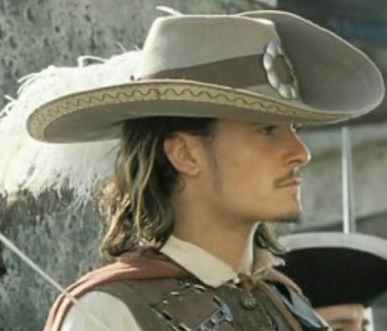
But speaking of Pirates and Hook, does it seem at the end of the first Pirates movie that Will Turner is trying to bring back the Hook-style pirate dress? He doesn't have the bright colors, but he's got the ridiculously big feather, the longish hair, and the wispy mustache.


Of course, everyone's first thought is that he's the fourth musketeer, D'artagnan's tag-along little brother, Pierre. But then again maybe Disney is tipping its hat to its first great pirate. Although, Hook's mustache has a bit more Dali in it than does Turner's.

Thursday, April 19, 2007

Abortion?(!)

In Gonzales v. Carhart, (click here for full-text of the opinion) the Supreme Court yesterday upheld a nationwide ban on certain types of abortions.

This kind of throws a wrench into the semester of jurisprudence my Con Law prof. has been laboring to construct since Christmas.

The law at issue passed both the Senate and the House in 2003 by a fairly large margin. It bans a specific (and fairly gruesome) abortion procedure. Today's decision is not a surprise, especially given the fact that the court's makeup has shifted a bit to the right since the last time an abortion ban was considered. The controversial aspect of the decision, though, is that it contains no exception to preserve the health of a mother. I does contain a life exception, but no health exception.

Is this decision significant? Not really. As a symbol, perhaps, but not in any real practical way. The radical right will trumpet it from the rooftops as a victory over godless secularism. The radical left will call it the downfall of civilization as we know it. In reality, over 90% of all abortions performed don't even come close to using this procedure. In those cases that do use it, other abortion procedures are readily available that are not outlawed. But regardless, get ready for the demagoguery from both ends of the spectrum. It's only going to get louder.

Separated at Birth?

Posting this picture of President David O. McKay on my last post,


I couldn't help but notice a resemblance to this other big white face.


Something in the mouth and the eyes...