Tuesday, May 29, 2007

The Eats Sheet: A Dallas Doubleheader

Long overdue, the Eats Sheet catches up to my several-weeks-in-the-past trip to Dallas, where I visited my aging grandmother. Today we look at two Dallas eateries: Calle Doce, and the Churrascaria chain, Fogo de Chao.

Calle Doce looked promising. This close to the border I suspected that we would be more likely to get some real comida Mexicana auténtica. What appeared to be an all Mexican wait staff and a menu filled with such favorites as siete mares and tacos al carbón reinforced my suspicions. A wandering guitar minstrel ambled around the tables taking requests. He even did a nice bachata rendition of Stairway to Heaven. Before we had time to peruse the menu and make our selections I ordered us a round of tostadas de ceviche. The tostadas did not disappoint even my high expectations. Instead of the usual tiny cubes of cod or whitefish, these were a nice red ahi tuna cut in thick three-quarter inch cubes, marinated in lime, dusted with spice, piled on a tostada and loaded with diced tomatoes and onions and sliced avocados. With a final squirt of tapatío and lime, they were perfect.


The rest of lunch, however, took a different turn. I had the fish tacos, and I may have been asking for alchemy to expect good seafood in the middle of the desert. On the other hand, the ceviche was fresh, so perhaps my hope for good fish was not so unfounded. At any rate, my hopes, founded or not, were dashed on the jagged shards of a hard and dried-out piece of mahi-mahi. The rest of the contents of the tacos were fine, but the foundation was wanting. To make matters worse, the rice, cooked with corn kernels, was greasy—not buttery, greasy; and was a sickly looking grey hue. The refried beans either came from a can or were made by a chef who for some unfathomable reason has mastered the technique of re-creating metallic savorlessness.


Maybe it was just a bad day, but the non-ceviche food at Calle Doce was not worth the $10-$15 per plate. With the porch-dining and the guitarrista, I give it high points for style, and for ceviche, but low for food. I still recommend Calle Doce, for the ceviche, but don’t bother on the rest.


Fogo de Chao just opened a Minneapolis Restaurant a month ago, and the place has been rockingly busy (which is appropriate, I guess, since they’re near neighbors with Hard Rock Café). Lines out the door at almost any time of day make it clear that Minneapolitans have quite a taste for carnivorous debauchery. I could declare in self-righteousness that I look with disapprobation at such wanton flesh-consumption, but it would be a thin mask for the fact that I simply can’t afford the $44.50 ($29.50 if you go for lunch) to eat at Fogo.


In Dallas, however, things were different. My Dad agreed to take us all out to Fogo. I have eaten at three other Churrascarias (Tucanos, Rodizio Grill, and a high-class NYC Churrascaria that I can’t remember), and against this background, Fogo, despite some high points, is middling.


Appropriately for an eatery of its manner, Fogo’s strongest point is its meat. Here I did not just get quantity (though that was abundant), I got quality cuts of meat. The filet mignon was especially good. If anything, a few pieces were a bit too rare. At one point I looked across the table to see my grandma working on a piece of cow-flesh so red I wasn’t sure it was dead. But too rare is better than too burnt.


The rest of Fogo, while good, did not live up to the meat. The fried polenta sticks were buried in cheap salty parmasean crumbs (as opposed to dusted with buttery shredded parmasean), and the fried bananas sat in a mushy pool of canola oil. I should add that neither of these facts stopped me from eating plenty of both. They were still good, despite a few drawbacks. The salad bar was surprisingly slim. Rice and beans were conspicuously absent. Maybe they were just trying to live up to the “everything’s bigger in Texas” mantra that’s chanted mindlessly by a thousand would-be cowboys, but I was shocked to see asparagus the diameter of glue sticks and palm hearts that wouldn’t fit inside a toilet paper tube. Both were decidedly un-tender and fibrously stringy—it was reminiscent of eating the wrong part of an artichoke.


Now, if you are going to a Churrascaria, it is true that you aren’t going to eat plate after plate of asparagus and fried polenta. The meat is the res and the rest is the rest. But even so, good meat should be in good company. Fogo’s meat is too good for the company it keeps, especially at the price. I recommend it with hesitation.

Saturday, May 19, 2007

Interview with Elders Nelson and Wickman


The Pew Forum recently interviewed Elder Russel M. Nelson (of the Quorum of the 12) and Elder Lance B Wickman (Church Legal Counsel). They discussed the church's public relations, specifically, how they are affected or not affected by all the recent and upcoming media attention to the church (Romney, PBS documentary, MMM movie, etc.).

I think Elder Wickman's response to the question about Americans being generally reluctant to vote for a Mormon did not do a very good job of reinforcing the church's political neutrality stance. However, I only found one doctrinal error in the article:

"The church considers the quorum second in ecclesiastical authority to the church's First Presidency..."

(Emphasis Added.) Not according to the Doctrine and Covenants we don't.

Guess who's back

Greetings. A full week and two days without a new post on WMBW. The reason for my sudden unexplained lack of wackiness (at least wackiness available for web viewing) is a little thing the Law Review calls "petitioning" and that I call "hell."

Basically, what happens is this: the Law Review editors give you 300 pages of stuff. The stuff includes one "main case" and a bunch of related cases, articles, book excerpts, blog posts, etc. Your mission, should you choose to accept it, is to read it all closely and come up with 10 pages of intelligent prose accompanied by 10-15 pages of intelligent footnotes. This is what is known as a case comment. To make matters worse, you have to do it in no more than a fortnight, and you have to use a referencing style that you have never been taught because those goons over at the Harvard L. Rev. have everyone convinced that their way is the only way to do footnotes.

In my case, it was even worse because my fortnight was cut down to about a week. All last weekend I was in Dallas, Texas visiting family, and starting on Tuesday, I'll be in Fargo, North Dakota getting trained. So why am I posting now if I have such short time to finish? I am what you call "burnt out." I discovered that doing this 14 hours a day eventually has that effect. A non-law related activity for 15 minutes is what I need.

After the petition thing is over, I can comment on the case. Right now, I'm required to not discuss it, at least not with any other U of M 1Ls. I don't know if any of them read this blog, so I better be safe.

Thursday, May 10, 2007

The Book Revue: Rough Stone Rolling


Joseph Smith: Rough Stone Rolling (Knopf, 2005) has been long awaited. Years ago, I read Bushman’s Joseph Smith and the Beginnings of Mormonism (1984, U of Ill. Press). It was fantastic. More thoroughly researched and more objectively and insightfully analyzed than most Joseph Smith bios, it was a great read.

So when RSR came out, I was excited to read it. School and finances delayed me a bit, but several months ago I received RSR as a gift and read it as quickly as 1st year law courses would allow.

Overall, it is great. As well researched as JSBM was, RSR begins with a biographical survey of Joseph Smith’s maternal and paternal ancestors and the cultural climate of New England at that time. It then moves through Joseph’s early life and continues with the founding of the church. The rest is, of course, history.

The overall theme of RSR is progressive development, or in very Mormon terms, line upon line. Sometimes we Mormons tend to think of the church and the priesthood as having sprung, Minvera-like, fully formed from Joseph’s revelatory head. In reality, Joseph himself learned the organization of the church and the priesthood one step at a time. Bushman looks at the different versions of the first vision as an expression of Joseph’s growing understanding of that experience and his growing confidence in his calling leading him to reveal more and more of what had happened to him. He also examines the ways in which the Book of Mormon itself contributed to Joseph’s view of himself as a prophet called of God rather than just another visionary preacher.

The challenge in writing about Joseph Smith is that he is such a divisive figure. Everyone has an opinion and everyone has an axe to grind, an agenda, or at least a bias. Bushman readily acknowledges that he views Joseph as an inspired prophet and regards the church and priesthood as authentic. But this does not prevent him from taking a close, critical look at the stories that have surrounded Joseph and using an astute historian’s eye to separate undocumented folklore from documented fact. For example, Bushman makes no effort to de-emphasize the fact that most of the Book of Mormon was likely translated not looking directly at the plates with the Urim and Thummim, but using a seerstone in a hat with the plates out of sight. This model can be challenging to those who have grown up with the seminary video version with the sheet hung between Joseph and Oliver, but it does emphasize that the translation was a revelatory experience. In addition, the seerstone version is actually more consistent with the Book of Mormon itself. (See Alma 37:23).

RSR
is heavy on analysis and a bit lighter on facts. It is still well-sourced, and it won’t be incomprehensible to a novice, but it will be better if you already have some foundational knowledge of Joseph’s life. For a less analytic, more factual bio, Donna Hill’s Joseph Smith: The First Mormon (1977, Signature) is a great choice. Bushman puts emphasis on the cultural context of the events in Joseph’s life, but also seems to want to explore the aspects of Joseph’s character that transcend 19rh century America. The book would be incomplete without looking at these transcendental strands, but Bushman waxes philosophical, almost rhapsodical at times. It is a different, though no less valuable approach than Hill’s very journalistic style. I recommend it.

Wednesday, May 9, 2007

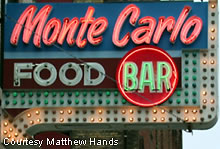
The Eats Sheet: The Monte Carlo, Mpls


Not to be confused with any place in Vegas, the Monte Carlo is probably the oldest eating establishment in the Minneapolis warehouse district still going. A century and a year old, the menu sports a solid American selection with an emphasis on traditional meat-based dishes. Steak and Salmon abound. Big, gravy-smothered open faced sandwiches are also a strength. When I get off the bus, especially during the winter, I am always tempted by the scents wafting out from the Monte Carlo's grill.

My first visit to the Monte Carlo, I had the Salmon Caesar Salad. Salad might be a bit misleading. In reality, it was more like a full grilled Salmon steak served on a bed of romaine with some dressing. Very simple, unadorned just a well-blended mix of a few flavors. The next time I had the cajun pork chops: three thin chops dusted with parika, pepper and rosemary served with fries. The spice was great, the meat was juicy (not always easy with pork). It lacked a veggie, though. It was good, but seemed a bit incomplete.

The restaurant itself is a bit like a midwest version of Monks cafe, but bigger. Waitresses were in classic black and white cafe uniform dresses. The main room opens up onto a huge copper-topped bar while booths extend toward the back. The ceiling is tin, and the lighting is low. You can almost picture a turn of the century lumber executive sitting in a cloud of cigar smoke in one of the back booths. But if you're eating during the day, it's a little too dim. Feels kind of unnatural. Outdoor dining is also available. Service is good, but not overly quick.

Overall, the Monte Carlo is a good place to eat, but at the price, it isn't a place where you'd want to go every night. Meals $10-$20.

Who's the one?

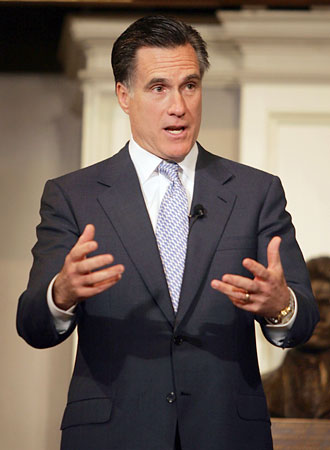
Look at this picture. I can't get the image, so you'll just have to click the link.

I'm not really sure what this is supposed to mean, but here are a few possibilities:
1. Mitt Romney is creating a clone army of himself, resistance is useless.
2. Some kind of weird Romney triumvirate is running for president.
3. The three identical Romneys juxtaposed with the phrase "he's the one" (emphasis added) is a kind of subliminal reference to the trinity, to make evangelicals feel better about voting for a Mormon.

But whatever it means, Romney is most definitely not "the one." As we all know, Nixon's the one.

Tuesday, May 8, 2007

Ranking the Batmen

Who is the best Batman? Who is the worst? Here's my take:

1. Christian Bale
2. Michael Keaton
3. Adam West
4. Val Kilmer
5. George Clooney

One of the keys of nailing Batman is the ability to play both the dark knight and the billionaire playboy. The great thing about Bale is that he plays both Batman and Bruce Wayne well. Most previous Batmen could only do one well. Keaton was a good Batman, but a pretty mediocre Bruce Wayne. Kilmer was okay at both, but just okay. Clooney was a decent Bruce Wayne but a terrible Batman. Plus, in that version, Joel Schumacher put nipples on the batsuit. That's just wrong.

Monday, May 7, 2007

A good reminder

The SLTrib's Bergera gives us all a reminder of a few things that will probably be ignored over the coming year.

Provo: the good, the bad, and the ugly.

The other night, on the way to Ben & Jerry's for some quality overpriced ice cream, I found myself missing some of my favorite Provo haunts. One of the greatest things about Provo is that eating out is cheap. That memory inspired these lists:

Things I miss about Provo:
1. Diego's.
2. Smart Cookie.
3. Smokehouse.
4. Climbing Timp, Provo Peak, and Cascade.
5. Sitting on a couch on a porch with three Italians eating quesadillas.
6. The corporal.
7. The temple. (No, really, I actually do like it.)
8. Steve Robinson's rants.
9. Jeff Ringer not reading my papers and giving me A's.
10. Friends who sound like Jimmy Stewart and have a teacher named George Bailey.
11. The HBLL.
12. The Provo library.

Things I do not miss about Provo:
1. Ward prayer.
2. Stadium of Fire.
3. Poli Sci majors that think they know everything.
4. The great cinder block caper of aught-five.
5. A grill-stealing landlord.
6. Artificial price supports imposed on the housing market by the BYU approved housing regime.
7. One-party rule.
8. Ghettoization of student housing.

Things from Provo on which I am ambivalent or indifferent:

1. The Homecoming Spectacular (more accurately known as the Homecoming OK).
2. Red Robin.
3. Darrell.
4. Beto's.
5. Walking around with the Shark on a hot day waiting for his car stereo to be installed.

Thursday, May 3, 2007

Is the new Mitt Romney more conservative than his own church?


That's what this Boston Globe article from December argues. The church links to the article on its own "newsroom" website. While that does not mean endorsement, it probably does mean that the church considers the article to be credible. Bennet, the author of the piece, makes the point among other things that both the current ardent pro-life Romney and the 1994 pro-choice Romney have a welcome place within the church, and that on the issue of stem-cell research, Romney's vehement opposition has placed him outside the mainstream of church members. The article actually does a very decent job of explaining the church's political neutrality and the church policies and doctrines that inform Mormon political opinions. It's worth a read.

Wednesday, May 2, 2007

That Krazy Kucinich


This is not a surprise. Dennis Kucinich, that diminutive Ohioan with a penchant for polka has filed articles of impeachment against the Vice President. As previous posts have probably made clear, I'm no fan of Cheney, but impeachment is a bit over the top. I will say this, however, Kucinich, or rather the interns in his office, lay out a pretty persuasive case, not persuasive that Cheney ought to be impeached, but persuasive that he's been dishonest and has not served our country well. Click here to read the articles of impeachment.

Whitney's "The Mormons": Reactions


After watching Parts 1 and 2 of Helen Whitney's documentary last night and the night before, I have a few observations. Overall, I thought it was well done and fair. I found myself frustrated at times that she wasn't telling the whole story. For example, the section on Polygamy presented the manifesto as something that was universally excepted by the whole church at that moment and ended polygamy in an instant. In reality, Mormon polygamy died a slow death. Even two Apostles, John W. Taylor, and Matthias F. Cowley were eventually excommunicated because of their refusal to abandon "the Principle." Greg Smith's FAIR article on post-manifesto polygamy gives a thorough and well-informed treatment. Though I'm not so sure about his conclusions, he tells the story well.

Giving the simplistic view, I think, cheapens the experience of Mormon polygamy and the inspiration of the manifesto. It is important to understand how much the pioneer saints had given and sacrificed for polygamy, and how long their leaders had preached it, to understand how hard it was to give up. Against this cultural background the courage and vision of the manifesto becomes clear. The simple view makes it seem like Wilford Woodruff was left with no choice and pressured into renouncing polygamy. In reality, the pioneer saints had "endured many things and hope[d] to be able to endure all things" to preserve what they believed was right. They would have gladly submitted to exile. It is too simple to say that the church dropped polygamy to get statehood. Polygamy was several orders of magnitude more important to men like John Taylor and Wilford Woodruff than was statehood.

Instead, a more holistic view takes the manifesto against that background as a visionary and progressive document. To essentially put aside 5 decades of church practice that had been tempered in the fires of Missouri and hardened through the plains and the deserts had to be more than mere capitulation to the federal government. Recognizing this, I think, recognizes the majesty and vision of the revelation behind the manifesto.

On the other hand, to tell the whole story would have been impossible in Whitney's medium. Polygamy would take the entire 4 hours. Her treatment was probably appropriate given the constraints.

Another criticism is that on a macro level, there was too much emphasis on the Mountain Meadows Massacre and on the September Six. These stories are important, but Whitney's states purpose was to give an outsider an insider's look at the Mormon experience. Many if not most Mormons know very little about the MMM and are not plagued by it. Whitney's devoting an entire 1/6 of Part 1 to the MMM made it seem like Mormons still have a guilt complex about it. I appreciated that Will Bagley's view was countered by Glen Leonard, but it would have been helpful to know that Bagley is on the fringe of the scholarly consensus on the MMM.

One last criticism: too much screen time given to Margaret Toscano and Tal Bachman. I've read most of Toscano's work. But her excommunication was not for her work and opinions as much as it was for her refusal to recognize that her own thoughts were not revelations to the entire church. She told the horror story of her church court but there was insufficient presentation of the other side. Part of that is the practical reality that disciplinary councils are confidential and the church does not publish those proceedings, so there really is only one side of the story out there. Whitney did acknowledge this, but it was brief. You could have easily missed it if you weren't paying attention. Bachman's remark that as a missionary he would have been willing to be a suicide bomber was inflammatory and totally unnecessary. It would have been helpful to counter that with a sane returned missionary. I was also annoyed by Bachman's insistence that he daily risked his life as a missionary. Sounds like a martyr complex to me.

Overall, though, I thought it was well done. The ending was great. I recommend it, but with the caveat that it is only a superficial treatment, a survey of sorts, and that only further reading will give you a more complete view. If "The Mormons" is the basis for all your knowledge of the Church of Jesus Christ of Latter-day Saints, your understanding will be superficial and lacking. But if you use "The Mormons" as a starting place for further reading, you will find it a great appetizer for a meatier meal.

What did you think?

Other resources:


Dave over at DMI has a nice list of the people interviewed with some info on each.

"The Mormons" website on pbs.org is a great resource with full transcripts of the interviews and more information.

The NYT gave it a positive review.

On Washingtonpost.com, Filmmaker Helen Whitney took part in a conversation with readers about the film. Her comments are worth reading.

Tuesday, May 1, 2007

Life imitates life

An old post over at Cabeza's talked about a co-worker who looked like the Lorax. Similarly, a woman at the university here bears an uncanny resemblance to Elton John.


As Cabeza obsoives, the obvious question hanging in front of everyone's mind is whether the people who look like things, or people, or fantastical creatures actually know what or who they look like. It seems that it would be obvious, or at least reasonably clear that Mr. Lorax or Elton Jane would be aware of their resemblance. But if so, that only raises a more perplexing question: why don't they do something to change their appearance?

In criminal law, each crime requires not only the criminal act itself, but criminal intent as well. Intent can be established not just if the defendant actually intended the act, but also if the defendant had knowledge that his actions would lead to that result, or if he knew that there was a risk that his actions would lead to the criminal result and proceeded reckless to that risk. So my question is this: if the resemblers know what they resemble, does that mean that they in some way intend to resemble? Can we infer intent from the fact that they act recklessly toward the risk that they might resemble singers and mythical forest protectors?

Monday, April 30, 2007

Blood spilling and life taking

Last week, Warren posted a few observations on violence over at Salsa Night. The post is worth reading. The main point Warren makes is that modern society is less violent that older societies. He looks at examples of animal cruelty in entertainment (bear bating, cat burning) and some violent sports to demonstrate this idea.

I think Warren is right. Violence has been much more commonplace historically than now. But I don't think we need to look as far back as bear-bating to bear the argument out. (Incidentally, the companion sport to bear-bating was bull-bating, and the terms bear market and bull market actually derive from these sports because a bear would swipe down at a pack of hounds, while a bull would buck up to throw the dogs, but I digress.) Our own history, even fairly recent history is much more violent than most Americans probably know.

We all know the Civil War was bloody. But we are for the most part ignorant of the culture of violence that produced the Civil War and that was rampant throughout the South and on the frontier. Perhaps the most salient example is Bleeding Kansas. For about 5 or 6 years beginning in 1854, slave-state Missourians free-state settlers from the east clashed at the polls and on the field. The problems started with the compromise of 1854 which set aside the Missouri compromise and established that slavery in the territories of Kansas and Nebraska would be decided by the settlers rather than by the Senate. Kansans were mostly free-staters, so slavery-favoring politicians in Missouri incited mobs of Missourian "border ruffians" to cross over into Kansas, illegally vote at the point of the bowie knife, and take over the polls, blocking free-staters from voting. The Missourian plan worked, and a bogus pro-slavery government was established. The free-staters refused to recognize the illegally cast votes and established their own government. For a time, Kansas had two rival governments and armed militias on both sides regularly raided the seats of each. The federal government vacillated its support between the two Kansas legislatures.

During this time it was not uncommon for partisans of both groups to murder each other on the slightest provocation (or none at all) often cutting off limbs, hands, fingers, ears, slashing faces, and otherwise mutilating and defacing their dead enemies. Similar depredations had been experienced by Mormons at the hand of Missouri mobs a decade earlier. A Boston woman visiting Kansas in 1855 wrote home about the unprovoked murder of a local free-state man: "The border Missourians are a horseback people; always off somewhere; drink a great deal of whiskey, and are quite reckless of human life. . . .To shoot a man is not much more than to shoot a buck." (1) The unwritten code in the South was that "killing was all right if any prior threat had occurred. Sneak attack, attack from ambush, attack on the unarmed or even the sleeping, attack on one by several did little to detract from the honor of these public. . . murders." (2)

And these acts of violence were not limited to low-life border scum. Kentuckian Senator Henry Clay, the great compromiser, fought in two duels and his reputation remained intact. President Andrew Jackson once killed an opponent in a duel and assaulted another opponent with a gun and a knife. (3) In 1856, Charles Sumner was famously caned---savagely beaten with heavy gold head of a cane---by South Carolina Representative Preston Brooks because of a perceived insult to a distant relative. The family feud was common in the antebellum South (and though not common, survived even into the post-bellum South). According to Mark Twain's Buck Grangerford, "a feud is this way: a man has a quarrel with another man, and kills him; then that other man's brother kills him; then the other brothers, on both sides goes for one another; then the cousins chip in---and by and by everybody's killed off, and there ain't no more feud." (4) Sumner, attacked by surprise, was blinded by his own blood and became trapped under his desk. Brooks continued to beat Sumner until he ripped the desk out of the floor, staggered up the aisle and collapsed, unconscious. Brooks walked up the aisle and resumed beating the unconscious Sumner until he broke his cane and then quietly left the chamber. Sumner's blood was smeared around his desk and lay in a pool on the floor. (5)

Since we Americans are cursed with historical Amnesia, it helps to be reminded how recent the civil war really was. At the time of the First World War, the Civil War was as recent as the Second World War is to us. As late as 1932, a Civil War combat veteran was serving on the Supreme Court.

I think Warren is right that we commit as a society fewer acts of savage violence than earlier generations. However, I wonder at our entertainment. While it is true, as Warren points, out, that medieval societies enjoyed violence as entertainment, and that we could look farther back to Nero's treatment of Christians in the coliseum for even more gruesome examples, there isn't much in American history in the way of a public spectacle that people would pay to see that compares with, say, 300 or Gladiator. Even more disturbing is the fact that often our entertainment violence is participatory rather than just a spectator sport. The games we play put us in the position not of watching violence, but actually committing it in fantasy.

Another variable in the equation is today's increased capacity to inflict harm. The savageries of Bleeding Kansas saw men hack each other to death with sabers and bowie knives, but today one deranged man can kill scores before he is apprehended or takes his own life. It is this combination of fantasy violence and technological capacity to kill that makes contemporary American violence so disturbing.

Notes:
(1) Hannah Anderson Ropes, Six Months in Kansas, Boston: John P. Jewwtt, 1854., see ch. 4

(2) D. Grimsted, American Mobbing, Oxford U Press, 2003., pp. 91-92.

(3) D. S. Reynolds, John Brown, Abolitionist, NewYork: Knopf, 2005., p. 160.

(4) M. Twain, The Adventures of Huckleberry Finn, 1885, New York: Norton, 1977., p. 89.

(5) Reynolds, supra, p. 159.

Friday, April 27, 2007

Citizen Cheney Part Deux, or, Dick Back in Black


Yesterday, envested in the black robes of a false priesthood, Richard Bruce Cheney received an honorary degree in public service from BYU and served as keynote speaker for the commencement exercises.

Predictably, he was welcomed enthusiastically by most of BYU (there was another protest and an "alternative commencement" but the organizers blew all their credibility when they included Ralph Nader). For me, the two most disappointing moments were 1) when the students applauded louder when Cheney's name was mentioned than when President Hinckley's name was mentioned seconds earlier, and 2) when the student giving the invocation thanked God for Cheney's presence and asked heaven's blessings first on Cheney and then only later did the same for President Hinckley. We thank the O God for a Vice President? Seems a little off to me. Maybe this student had Luke 6:28 in mind---perhaps the Vice President has not cursed the Mormons, but he sure did (despitefully?) use us for political gain.

I was wrong about one thing: I predicted that Cheney would use the commencement as a political forum. His speech was not overtly political. He mentioned politics only in passing. It was a short, relatively bland speech. There are a few possible explanations: 1) Cheney realizes that the administration is beyond recuperation and a political speech would have been in vain. 2) Cheney realizes that his audience is already in the bag and a political speech wouldn't accomplish anything that isn't already accomplished with Utahns. 3) The First Presidency, when they accepted Cheney's self-invitation to speak, explained the purpose of commencement and asked him to leave politics off campus. 4) Cheney himself realized that a political commencement speech was inappropriate. 5) Cheney knew that his purpose (to give the impression of church approval) was already accomplished by the fact that he got to be commencement speaker and he also knows that most people ignore commencement anyway so he didn't bother putting much effort into it.

The speech itself was not an awful speech. It was not a very good speech either. Very mediocre. One moment of perhaps unintentional honesty gave me a chuckle with Cheney saying "my entire political career has been an unplanned enterprise." Well, isn't that what we've been saying about the invasion of Iraq?

I know it's a tradition to give honorary degrees to speakers, but I was still disappointed that Cheney received a degree in public service. Especially since Pres. Samuelson kept emphasizing that this is the highest honor that BYU can give, and that it is only given to people who have demonstrated outstanding service in some way. Being VP is an accomplishment, but accomplishment and service are not the same thing; it is debatable at best that Cheney has done any public service. Pres. Samuelson didn't even give any examples of his alleged service, he just gave a run-down of his political career. Somehow, I feel, viscerally, even though I know that it is logically absurd, that my own degree is somehow sullied or cheapened. I'm just glad I graduated last year. It smarts, but it will fade.

You can still watch commencement here.

A friend's blog

NT, a friend and classmate, is writing political commentary over at The New Right. NT and I disagree on almost everything politically, agree on almost everything socially, and are pretty much half and half on economic policy questions. If you need some more conservative fire-eating in your life, check it out.

Utah County and the magic world view


This is pretty unbelievable. Utah County Republican believes that Satan is behind illegal immigration and offers a proposal at the County GOP convention to formally oppose Satan's plan to destroy the United States through illegal immigration and set up his New World Order.

I just wonder if this means that carne asada is smoked over the fires of hell.

Thanks to Nick over at Salsa Night.

Thursday, April 26, 2007

Lyrical Power Ballads: Installement the Second

Here's a poem I've been tinkering with for the past several months.

Thoughts on the Mpls housing projects


From the window of the law school library
—the way the early morning light plays off the golden leaves of a sycamore,
gradually lights across a green slope, manicured and trimmed,
while pines throw their shadows down the grass—

out of obscurity
the towers rise, seemingly ex nihilo,
materializing in the shadows as the morning breaks on them,
valleys of concrete crags, the everlasting hills of the metropolis.
Sheathed in mismatched panels of unwanted cast-aside colors,
the towers hang in picturesque, pathetic majesty.

What Dickensian scenes will play out in dismal rooms today?

O, the nobility of the poor!
Apotheosized like inhuman Olympians,
cold alabaster, eyes plucked out,
their lifeless, stony heroism
incapable of sin, of sorrow, incapable of joy—

To us, devotees, their poverty becomes a quaint fable
that ends with a contented quietist moral,
an old lie.

This is too extravagant to be maintained.


I await feedback.

Wednesday, April 25, 2007

The Eats Sheet & The Book Revue: The Dinosaur Bar-B-Que

In this post, the Eats Sheet and the Book Revue join forces to review the Dinosaur Bar-B-Que: the restaurant, the book, the legend.

The Legend
The original Dino BBQ was a road outfit, peddling their smoked meat wares at state fairs and biker gatherings. After 5 years on the road they opened the a restaurant in Syracuse, NY in 1988. At first just take-out, they expanded to include a bar and live blues before long. In 1998 the Rochester location opened in an old station of the defunct Lehigh Valley Railroad, overlooking the Genesee River. In 2004 the Dino opened its third restaurant, in Harlem.

The Restaurant (Rochester)

The first and most important thing you need to know about the
Dinosaur is that the food is absolutely fantastic. Not surprisingly, barbeque stand-bys like ribs, smoked brisket, and pulled pork are the foundation of the menu, but Stage's years on the road took him all over the south, and the Dino's brand of 'que is a dusky blend of authentic influences from Texas to Memphis. In addition, there are strands of Asian, Cuban, and Creole influences laced throughout the menu. Because the Dino is a rib joint, you would be remiss to not try the ribs, but the combo plates and the BBQ samplers are a good way to get a wide taste of the menu.

The goodness doesn't stop with the main dishes, though. Part of the Dino's appeal is the sides menu. My three favorites are the fresh cut fries (always crisp, never limp), the Cuban Black Beans (a great accompaniment to pulled pork), and the Honey Hush Cornbread. The Dino also has Saranac Root Beer available on tap (it comes in pints) and a variety of bottled root beers (including Pirates' Keg). If you're looking for wings, though, don't come here. The BBQ chicken wings are good, but they are not the Buffalo Wings that you would find in an average upstate New York pizza joint. In addition to a rockin' menu, the Dino also has rockin' tunes. Several nights weekly the Rochester location hosts blues artists, some local, some national. The tunes are always good. Plan to spend about $15/person to really get a good experience, but you can get cheaper meals. Vegetarian options are available (smoked portobello burger), but I don't know why you would go here to eat vegetarian.

The Book
The great thing about the Dino cookbook is that it is not just a set of instructions to make a product. It is a book of principles that can be applied in practice to the craft and the art of fine bar-b-que food. Think of the recipes as canvases on which an artist can work. It includes important instructions on how get authentic smoker flavor out of a tiny kettle grill, how to avoid overcooking a piece of meat, and how to tell when a stake is done without piercing it with a thermometer and letting all the juices out.

The book also tells you how to develop a palette of basics from with to work your art. How to create spice rubs, sauces, and marinades. My favorite dishes out of the cookbook are the Oven Roasted Mojito Chicken, and the Cuban dish, Ropa Vieja. If you're looking for a quick meal, don't look to the Dinosaur Bar-B-Que cookbook. If you're willing to donate an afternoon or even a weekend to the creation of culinary art, this is a great place to start.

The book is available on the Dino's website, but it is cheaper if you get it from Amazon.

Tuesday, April 24, 2007

Citizen Cheney, or, Wah! Err! Um! Wah!

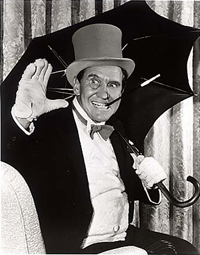
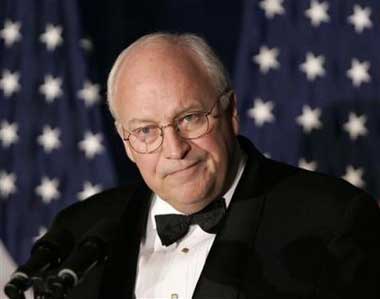
Yes, the Cheney-The Penguin comparisons have grown so commonplace as to almost be tiresome. On the other hand, perhaps the longevity of the comparison is an indication of the fact that it rings so true. If its a tiresome joke, its only because it's so easy. In a Penguin look-alike contest, Cheney would probably beat out FDR even sans cigarette holder. But it is a pretty close race:


As many of you are aware, Old Dick himself will be speaking at commencement at Brigham Young University this Thursday at 4:00 PM Mountain Time. You can watch it here by clicking on "tune in now". After all that's been said about Cheney at BYU, Eric Snider's piece is the most insightful.

My take on it: BYU's decision accept Cheney's self-invite to speak isn't the end of civilization as we know it, but it probably was ill-advised. Were BYU an average run-of-the-mill independent private school, there wouldn't really be anything wrong with it beyond the bare fact that Cheney is unpopular and annoying. But BYU is not an average private school; it is the flagship educational institution of a major religious organization with a declared commitment to political neutrality. I don't think BYU in the abstract should refrain from inviting political officials, even controversial ones, to speak on campus. But the question cannot be considered in the abstract.

1. This is not just a speech, this is commencement. Commencement ought to be apolitical. Anyone who thinks that Cheney will not use commencement as a political platform is fooling himself.

2. Commencement gives the impression that the University endorses the speaker. Speaking at a forum is speaking to the University community, but speaking at commencement is in most people's minds, speaking to the graduates on behalf of the University.

3. This comes at a time when only one other campus has allowed Cheney to speak at commencement, and when the Administration's approval ratings are beyond abysmal. In this environment, accepting Cheney's self-invite could easily be construed, right or wrong, as some kind of implicit endorsement.

4. BYU, despite its efforts to be even-handed, has a pattern of inviting more conservative speakers to campus. Inviting Cheney only reinforces this pattern and in doing so, undermines the Church's effort to be politically neutral.

It has been suggested that inviting Tom Lantos to speak a few years ago balances inviting Cheney. The comparison is flawed for several reasons. First, Lantos' wife is a Mormon; it is not unusual that BYU would invite someone with ties to the LDS community, regardless of politics. (The same is true about Harry Reid, who spoke at BYU Law commencement a few years ago). Second, Lantos himself is a holocaust survivor. Someone with that kind of experience is a good speaker to have regardless of politics. Third, Lantos is only one of hundreds of members of Congress. Cheney, on the other hand, is the number two of a co-equal branch of government. While it is true that democrats have spoken on campus, to get one comparable to Cheney in national profile and party stature you have to go all the way back to Bobby Kennedy's speech at the Smith Fieldhouse in 1968; and he didn't even speak at commencement. (On the other hand, that was during the Wilkinson years; the fact that he even got on campus is kind of a big deal).

I think part of the issue here is that the BYU administration sees the world through Provo-colored lenses. In that worldview, there's nothing partisan or that even appears partisan about BYU's choice of speakers. But BYU is not a regional school anymore, it is a national school, and it represents an international church. From a national or international perspective, BYU's choice of speakers tends to lean to the right.

Let me be clear: I don't think BYU or any other school has a legal or an ethical obligation per se to be even-handed in its speakers. But if the First Presidency is going to continue to insist on partisan neutrality, any appearance of a lack of neutrality in BYU is damaging. This is even more so now that media attention is shifting towards Mormons for a variety of reasons (Romney, the PBS documentary, the Mountain Meadows Massacre movie, Kyle Sampson, etc.).

However, the fact that BYU has invited Cheney to speak at commencement and the backlash against that decision have put the administration on their toes. This could mean that BYU will make a greater effort to invite political figures from both sides. At least one of my old profs has said that he will donate nothing to the Alumni organization until BYU invites the anti-Cheney to campus.

Further Reading:
Provo Daily Herald: "Opponents Organize Against Cheney Visit"
CNN.com: "Students peacefully protest Cheney's upcoming appearance at BYU"
A blog with pictures of the April 4th demonstration