Showing posts with label Historicisms. Show all posts

Monday, October 13, 2008

The Eats Sheet: Lentil & Spinach Soup

Autumn is a time for soups. When the temperature begins to dip, it's nice to have some pot of tastiness bubbling away on the stove filling the home with good smells. With the farmer's market abounding in all manner of squashes, I'm looking forward to trying my hand at Cabeza's latest offering.

Over the weekend, though, I discovered a new arrow to add to my quiver of soups: Lentil and Spinach. Lentils, the bean's less imposing cousin, are a perennial favorite of birkenstock-wearing whole foods shoppers. But they can also please a more refined palette. Less gassy and quicker-cooking than beans, lentils are sometimes translated in the King James Old Testament as "pulse," and were famously eaten by Belteshazzar (aka Daniel) and his three friends Shadrach, Meshach and Abed-Nego when they eschewed the Babylonian King's meat and wine. Since lentils are high in complex carbohydrates and a good source of iron, they're an important staple to a vegetarian diet; it seems the Hebrew expatriates were right to use them rather than meat.

If prepared wrong, lentils are utterly flavorless. Simply boiling them in plain water will not do. You get a bland, gag-inducing mess that's pretty hard to choke down. It's also a mistake to overcomplicate lentils by overwhelming them with with other flavors. They'll taste good, but they won't taste like lentils. But with a few simple accents, you can bring out their natural nuttiness and make lentils good---good enough to trade a birthright for.

This recipe begins with three or four slabs of bacon chopped up into slightly-smaller-than-bite-sized pieces. Throw them in a soup pot over just under medium heat. You want the bacon fat to melt out without burning or browning too much because you're going to use it to sautee some veggies. After about 6-7 minutes, throw in a half a yellow onion, and half a carrott, both finely chopped. Tip the heat up just past medium and let the onion get translucent, while the bacon fat browns just a little on the bottom of the pot. Then throw in two garlic cloves, finely chopped.

After a minute or two, toss in a tablespoon of tyme, a scant teaspoon of salt, a sprinkling of cracked pepper, and a cup of lentils. I used brown, but I suppose any color lentils would do. Scrape up any browned bacon fat from the bottom and dump in four cups chicken broth, a cup of water, and two tablespoons of tomato paste. Crank the heat up to high and get it boiling. Then knock it down to low, cover the pot, crack the lid, and let it simmer.

When the lentils are nice and tender (25-40 minutes), turn off the heat and dump in three packed cups of chopped baby spinach. Let the spinach soak up the flavor and wilt for about 3 minutes. It's done.

I served it with sliced apple and sliced cheese. I also topped off the bowls with some parmesan. To make a more substantial lunch today, I supplemented the leftovers with some leftover rice. It was a good addition. I also think barley or some small pasta could work well instead of rice. I'm also toying with the idea of using quinoa, which I think might be a nice complement to the earthiness of lentils.

The idea of Daniel and his three fire-proof friends sitting down to a bowl of this stuff makes me smile.

Thursday, December 20, 2007

Gun, Control.

Last week the NYT published an editorial by Adam Freedman about the Second Amendment case we're waiting for the Court to hear. Freedman blogs at Party of the First Part about the ongoing battle between legalese and plain English. I like Freedman. I identify with his obsessive disdain for legalese and love of plain Anglo-Saxon syntax. Freedman's editorial does a good job of summing up the textual wrangle in way that is precise, thorough, concise, and accessible. Well done.

New post on new blog: Why Democrats should be pro-life.

I've been invited to blog over at The Council of Fifty, a new blog about politics and Mormons (the name was my idea).

The original Council of Fifty was organized by Joseph Smith just prior to his death. The idea was that it would be a sort of political wing of God's Kingdom, while the church was the spiritual wing. The wikipedia article on it is pretty good. Two articles published in BYU Studies in 1980 give a more complete historical treatment. The first, by Michael Quinn, lays out the basic chronology and purposes. The second, by Andrew Ehat, attempts to answer some of the questions that Quinn raised and gets more into the theological background and purposes of the council.

This Council of Fifty is about discussing politics as it relates to Mormonism. My first post is about why the Democrats should be more open to running pro-lifers, especially for the Presidency. Here's a summary of my line of thought:

A less militantly pro-choice Democratic party would diffuse the potency of the abortion card. This would be good for the Democratic party, good for Mormons, and good for the Republican party as well. It would be good for Democrats because they could expand their base. It would be good for Mormons because it could help bring balance to the one-sidedness of political affiliation among Mormons. This in turn may give Republicans more incentive to attract Mormons, or at least to stop tolerating the anti-Mormon rhetoric from the fundamentalist wing of the party.


Of course, this is all speculative. But that’s what makes it fun.


So, really this post comes down to a few observations and a conclusion: (1) the Democrats are trying to ride a wave of populist discontent with the Bush administration and its blunders, (2) populist movements are only successful if they represent what is popular, (3) a hard-line pro-choice stance is out of line with what is popular, and (4) a hard-line pro-choice stance is not crucial to the party’s most important goals and ideals, especially not in presidential politics. Therefore, it makes sense for the party to moderate bit more on the abortion issue.


Read the entire post here. Leave comments about the argument there, comments about other stuff here. I don't want to poach the discussion.

Thursday, December 6, 2007

Gun control?(!)


About two weeks ago, the Supreme Court granted certiorari to decide District of Columbia v. Heller. Heller is a Second Amendment challenge to D.C.'s gun law, which prohibits handguns within the district (with an exception for retired police officers) and requires that long guns be kept either secured with a trigger lock or dissembled.

This challenge to the 32-year old D.C. gun law was initially rejected by the Federal District Court for the District of Columbia in 2004. In March of last year, however, the D.C. Circuit Court of Appeals overturned the District Court's decision. See Parker v. District of Columbia. That it is now before the Supreme Court is significant because the Court has addressed the Second Amendment head-on only once---and that was almost 7 decades ago.

In Miller v. U.S., a prohibition-era case, a bootlegger was prosecuted for taking an unregistered sawed-off double-barreled 12-gauge shotgun across state lines, which was a violation of federal law. The bootlegger, Miller, argued that the federal law was an unconstitutional restriction of his right to keep and bear arms. The Supreme Court rejected Miller's Second Amendment challenge, holding that he had failed to prove that his "possession or use" of a sawed-off double-barreled 12-gauge shotgun had "some reasonable relationship to the preservation or efficiency of a well regulated militia."

The Miller court did not hold that one has to be a member of a state militia to lay claim on the Second Amendment. However, it did say that that the "possession or use" of a firearm has to be reasonably related to the militia in order to be protected by the Second Amendment. Under Miller, the question is whether the possession or use of handguns in the District of Columbia is in some way related to a well-regulated militia.

Curiously, though, the D.C. Circuit refused to approach the issue under the Miller holding. Instead, it asked whether the Amendment protects the individual right to have guns, or the collective right to bear arms. This individual vs. collective question had been a point of controversy among law professors and academics, and the historical and linguistic evidence is pretty evenly stacked on either hand. But the odd thing is that Judge Silberman and my old Stake President could have avoided taking sides in the controversy if they would have just asked the question presented under Miller.

Why did they do this? They could have just said that owning handguns in D.C. is related to the militia and ended it there. Instead, they spent the time and effort to take sides in the whole individual/collective debate. Why? My best guess is that it is ideologically driven (though probably completely sincere). The D.C. Circuit is a conservative court and it is popular among conservatives to support gun rights. See, for example, Mitt Romney's recently having joined the NRA become a life-long hunter. The current ideologically orthodox position for conservatives seems to be the individual rights position. In 2001, for example, John Ashcroft wrote a memorandum changing the official position of the department of Justice from the collective rights to the individual rights view. The memo is appended to the government's brief in Haney v. U.S..

I think it was wrong for the D.C. Circuit to address the question the way it did rather than stick with the Miller precedent. But what I think is irrelevant, now, because the case is before Johnny and the Supremes and they don't have the same obligation to respect precedent that lower courts have. Not much is known about the individual Justices' views on the Second Amendment, but the speculation is that this relatively conservative Court will approve what the D.C. Circuit did. So it will be interesting to see how it all goes.

Friday, November 30, 2007

You and your racist friend.

In case anyone read the hate crimes posts and wasn't all that familiar with Nat Turner, here's a pretty decent documentary bit that explains part of his slave rebellion. The segment also details some of the most pernicious, insidious, disgusting, and just plain evil misuse of the scriptures that corrupted southern Christianity has ever produced.


I'm reminded that J. Golden Kimball once quipped, while serving as President of the southern states mission, that "the only way to redeem the south is burn it all up and baptize for the dead."

Monday, August 27, 2007

Seeking by study and by faith in Nauvoo.

We visited Nauvoo last weekend. Being only half a day's drive away and having Grandparents (free lodging and food) left us with little reason not to do it eventually. Last weekend we had the time, and we availed ourselves.

We saw the LDS sites Saturday. Sunday we drove down to see Carthage (also run by the LDS church). Monday we saw a few LDS sites in the morning before taking the Community of Christ tour in the afternoon. At the LDS sites we saw the blacksmith shop, the family living center (demonstrations on how they made bread, rope, rugs, baskets, etc.), the Heber C. Kimball Home, the Wilford Woodruff home, the Brigham Young home, and the Sarah Granger home. We also saw a play put on by the performing missionaries at the visitor's center and went on a wagon ride around old Nauvoo. The LDS sites are open on a walk-in basis, which gives a lot of freedom to the visitor to be flexible with what he wants to see. The Community of Christ sites (with the exception of the Red Brick Store) are open only as part of a tour of the whole area. The tour starts off in the visitors center, goes to see the graves of Joseph, Hyrum, and Emma Smith, then to the Smith Homestead, then to the Nauvoo House, then the Mansion House, and ends at the Red Brick Store.

Dave had a good post over at T&S about what goes into the management of historical sites. It's worth reading and leads one to appreciate the complexity of that job and the relative competence with which it is done. Right now, though, I'm more intrigued by the differences in historical presentation between the two latter-day saint tradition churches in Nauvoo.

I.
First the LDS sites. The one difference between the LDS sites in Nauvoo and other church history sites I've seen is that this time the missionaries made no effort to get us to fill out referral cards. I heard at least two missionaries specifically say that the Nauvoo Mission is a mission more to "strengthen the members" than to proselyte. I wonder if this is a recent change in emphasis. Other than that, it was pretty much what you see at most Church history sites: a tour, a story, and a testimony. There was more emotion, more sentimentality, more personal connection, and more passion. In the blacksmith shop and the family living center, however, there was less spiritual emphasis and more of a focus on hands-on experience and getting an idea of what life was like in the 19th Century. The Visitor's Center was similar to most LDS Visitor's Center's I've seen. There was a big information desk with lots of pamphlets, a diorama of Nauvoo, a few theaters, some art exhibits, and a huge copy of the Christus right in the center of the room. It was also full of loud families with lots of kids. There was no souvenir shop, nothing for sale. Altogether, it was a pleasant, fun, family-oriented building.

The first difference I noticed when we entered the Community of Christ visitor's center is that it was much quieter. Acoustic arrangements of some of the early Mormon hymns were played in the background. It made for a more reverent atmosphere (though this might have been because we were the only ones there). A young bearded man greeted us, told us when the tours would begin, and invited us to have a look around. First we had a look at the small gift shop. I was surprised to find some real historical titles. I expected some fun little story books, but instead, they had Bushman's and Donna Hill's Joseph Smith biographies, Dan Vogel's and Grant Palmer's books, a two volume set of the original manuscript of the Book of Mormon, and lots of other serious academic studies. In the main room, there was an original sunstone and moonstone. They also had the southeast cornerstone from the temple on display. The cornerstone was fashioned as a stone box, inside of which was placed a time capsule of sorts containing a copy of the original Book of Mormon manuscript, some periodicals, some coins, other memorabilia. Most surprising to me was that they had an original first edition Book of Mormon on display and it was only behind a regular glass display door, not like the sealed glass case that houses an original first edition at the LDS-run Grandin Printing Press in Palmyra. In keeping with the academic orientation of the books at the gift shop, the Community of Christ tour was very historical, very fact-oriented, not at all emotional, sentimental, or spiritual. Our guide was knowledgeable enough to answer specific questions about names and dates by citing historical authorities. There was no testifying. We were not invited to learn more about the spiritual or doctrinal message of the Community of Christ.

II.
On the one hand, I really appreciated a break from the sentimentality and seeming emotional manipulation that you sometimes get from the LDS tour guides. I appreciated being able to get good authoritative answers to specific historical questions, answers that I could look up and verify. I enjoyed hearing more about the surrounding economic and social context of the events described to create a fuller picture combined with the spiritual context. I was glad to learn more about the Smith family that stayed in Nauvoo. I liked the relaxed nature of a tour without a proselyting goal. We were treated very politely and respectfully.

But I missed some of the passion and personality that you get from the senior couples at the LDS sites. I missed hearing about why this is important to the person speaking. I missed the spiritual conviction that we felt at Carthage. This sense of missing something became most poignant in the upper room of the Red Brick Store. Sitting in the room where endowments and sealings were first introduced, I wanted hear about it. But the endowment and sealing ordinances, the most complex and interesting and the most exalting of the ordinances revealed by Joseph Smith, were reduced to a footnote, almost an afterthought; no more notable than the muslin covering on the desk where Joseph would record his purchases. It was here especially that I felt that something important had been lost along with all the sentimentality and emotional gushing.

III.
Emotions are a funny thing. They are so easily confused with the promptings of the Spirit that they are often mistaken for them, and sometimes missionaries, both the proselyting and the tour guide kinds, try to invite the spirit by tugging at the emotions. Usually, it doesn't work, and usually it leaves someone feeling awkward and uncomfortable. (Remember, the Spirit is called the Comforter). By contrast, the Spirit is supposed to edify. I've seen too many people mistake a rush of emotion for a spiritual manifestation of some kind, putting their faith in it, only to have it come up shallow later on and conclude that the spirit is all a farse and the gospel isn't true. It's for these reasons that I wish we could purge ourselves from sentimentality and emotional manipulation.

I'm also reminded that, according to Joseph Smith's prayer at the dedication of the Kirtland temple, were should not seek spiritual experiences alone; we are also supposed to seek learning as well---not just by faith, but "by study, and also by faith." I don't expect a tour guide to present the tour with the knowledge of a professional historian. It would be long, boring, and irrelevant to most of the patrons. But a tour guide is a teacher and a teacher ought to know his material more deeply than he teaches it. Truth, according to the revelations, is not just an abstract spiritual experience, but is knowledge of things as they are, and as they were. Truth, especially historical truth, is inherently fact-based. It is true that often we can do no better than approximations and guesses, but our guesses ought to be as good as we can get, as faithful to the historical record as we can be. Joseph Smith, taking a cue from Paul, warned the early saints to avoid zeal without knowledge (see Nibley's discussion of Joseph's warning).

The Community of Christ tours seemed to have a better handle on this kind of fact based history. But on the other hand, as Paul says, "knowledge", unchecked by charity, "puffeth up". Spiritual things cannot always find expression in the language of the knowledgeable. The omission of endowments from the Red Brick Store left me feeling like I had missed out. The LDS missionaries were less knowledgeable, but more personal; less accurate, but more memorable; less academic, but more passionate. Something was gained, and something was lost.

So my question is this: does a re-orientation towards a more historically accurate approach necessarily lead to a loss of conviction? Or is it possible to be both knowledgeable and spiritual? Is there something that the LDS site missionaries and the Community of Christ tour staff could learn from each other? How can we both improve our presentation of history?

Friday, August 10, 2007

A Retraction

We who might be windmills are not accustomed to being mistaken. Nevertheless, we are human and it does happen at times. In a recent post I wrote the following:

The gospel really does infuse everything I do, like it or not. So is my attempt to banish it a Canute-like futility?


The allusion is to King Canute the Great, or Cnut, or, Knútr inn ríki, in Old Norse, a Viking King who ruled over Norway, Denmark, part of Sweden, and the British Isles at the turn of the 11th Century. According to legend, Cnut tried to command the waves to turn back. The version I was familiar with was that Cnut, drunk on his own power, issued his anti-tidal edict, and when it returned to him void, resigned his crown in a fit of sour grapes.

According to the source of all human truth, though, I was misinformed. The true legend is that Canute, a fair and just king, had little tolerance for flattering courtiers. When one such flatterer told him that his power was so great that he could command the waves, Canute set out to prove him wrong and make a point. At either Southhampton or Westminster, Canute stood on the shore and commanded the sea to turn back. When, expectedly, it did not, he declaimed to his courtiers that even a king has limited powers. He then piously removed his crown and refused to wear it as a demonstration that Christ is the only true king.

Far be it from me to malign a royal dead viking. I don't want this Cnut character pulling a King Hamlet's Ghost and appearing to me in the middle of the night, or worse appearing to one of his descendants and ordering the unlucky sinner to avenge him by taking my life.

Cnut, my apologies.

Monday, July 30, 2007

The Book Revue: The Politics of American Religious Identy, by Kathleen Flake


Since it's been a few weeks since I finished it, I owe an installment to the Book Revue. Kathleen Flake's The Politics of American Religious Identity: The Seating of Senator Reed Smoot, Mormon Apostle is worth a read for anyone who has interest in Mormon history, the decline of the Protestant political establishment, or church-state issues in the U.S.

What you have to know about Kathleen Flake is that she is incredibly smart. She possesses not only a historian's ability to survey huge amounts of material, but also the analytical gift of distilling a clean, precise, conclusion. She combines these scholarly gifts with the faith and experience of living inside the Mormon church. As a result, her writing is simultaneously challenging and uplifting to faithful and outsiders alike. I was first introduced to her through her 1992 Essay "Supping with the Lord: a Liturgical Theology of the LDS Sacrament." Her thoughtful analysis of one of the core ordinances of Mormonism takes a look at the similarities and differences between the two prayers, and between this ordinance as compared to other Eucharistic rituals. The combination of close textual analysis and thoughtful faith is rare in a world where writing about religion too often devolves into criticisms or apologetics.

This book is no different. In it, Flake examines how the church went from being an isolated polygamous, theocratic sect holed up in the Rocky Mountains to being the integrated conservative, uber-American, ultra-patriotic, nuclear family centered church that it is today. The traditional narrative accepted in Mormon studies placed the crux of that transition at the moment of President Woodruff's manifesto.

But one major problem with the traditional narrative is that the manifesto was in many ways a non-event. The church was locked in a fight with the republican federal government, both sides committed to win, and the situation changed very little immediately after the manifesto. Though we take it seriously today, it wasn't always regarded as so binding. While "the church" didn't sanction or solemnize plural marriages after the manifesto, several apostles did, with knowledge (and some have argued, implicit approval) of the President of the Church. While the excerpts appended to the manifesto in the current printing of the scriptures uses the language of revelation and vision, The language of the manifesto itself presents itself not as binding, but as "advice," and grounds itself not in revelation, but in the fact that plural marriages are "against the law of the land." (Greg Smith's article gives a more comprehensive view of post-manifesto polygamy). There were enough Mormons still continuing to marry polygamously that President Joseph F. Smith issued what is sometimes called the "Second Manifesto" in 1904. The major difference from the 1890 manifesto is that it specifically threatened excommunication to solemnizers of plural marriages. The fact is that the 1890 manifesto was not the colossal moment that some historians have made it out to be.

Flake's book asserts that it was Reed Smoot's election to the Senate that precipitated the change associated with the Second Manifesto. She details how the Senate at the time was dominated by a powerful but weakening protestant establishment; not an organization, but the informal cooperation of individuals and groups with a shared understanding and agenda. The Smoot hearings were the clash between the (largely) republican protestant movement and the Mormon church. Bent on destroying the remaining "twin relic of barbarism," the republican party was not going to back down. However, this time the fight was political; it was fought in committee rooms rather than on the battlefield and in the courtroom and the jailhouse. The result was compromise and accommodation on both sides.

But most surprising to me, was the portrait that Flake paints of Joseph F. Smith. I came away from this book viewing President Smith not just as a prophet, but as a brilliant strategist who was forced to act as an intermediary between the hostile federal government and his own people. Flake explores how at the same time he committed the church to the eradication of polygamy, President Smith also began to place renewed emphasis on the First Vision to ensure that the church would not lose its uniqueness. With its commonwealth assimilated, its independence a thing of the past, and its most distinctive practices abolished, President Smith turned the church to its distinctive doctrines.

And one need not worry that Flake's book is damaging to Mormon faith. While I wouldn't make it part of the Sunday School curriculum, it tells a faithful, honest story. It must be remembered that Flake is a Latter-day Saint, which makes it clear that while the issues raised by this period of church history may challenge the understanding, they do not have to destroy or weaken faith. Recently, even Elder Dallin H. Oaks of the Quorum of the Twelve spoke favorably of this book, calling it "the best thing ever written on [the church's transition from isolation to assimilation]." On Joseph F. Smith's role in the transition, Elder Oaks says that Flake "
wrote about that so movingly, and I’d never thought of it. That was something that was new to me, but it rang true." (Read the whole interview here.)

Bottom line: The Politics of American Religious Identity: The Seating of Senator Reed Smoot, Mormon Apostle is a great, well-researched, and thoughtful book. It ought to be required reading for anyone interested in studying Mormon history at the turn of the century.

Tuesday, July 3, 2007

Independence Day: ¡Viva la revolución!


In Church on Sunday we sang the “Battle Hymn of the Republic” to open the meeting. The “Battle Hymn” has a kind of earnest Victorian-esque zeal worthy of Shaw’s Major Barbara. Until recently, I always thought that this rousing Christian hymn predated the uncouth and irreligious “John Brown’s body lies a-moulderin’ in the grave” and that the good Christian version was the original.


But I was wrong. “John Brown’s Body” was a folk song, and like all good folk songs, has no identifiable author, but is the anonymous collective product of the great mass of un-elite humanity. It originated during the civil war among union troops who would sing it to lift their spirits and to convince themselves that they were fighting for the end of slavery.


Later, the daughter of a Lieutenant Colonel in the Continental Army Christianized “John Brown’s Body” by rewriting it, removing those pesky, possibly idolatrous references to Osawatomie Brown and replacing the marching of Brown’s soul with the marching of God’s truth. But even with these variations on the original theme, the origins of Howe’s “Battle Hymn of the Republic” are anchored squarely in the Civil War and specifically, with the call to end slavery. When Howe admonishes “as he died to make men holy, let us die to make men free,” it isn’t just some abstract kind of freedom she is talking about, but real physical, freedom. This makes the hymn more visceral to me, and therefore, more powerful.


And it seems, to quote another Civil War text “altogether fitting and proper” that I should commemorate Independence Day by remembering not just Lexington and Concord, Valley Forge, and Yorktown, but also Harper’s Ferry, Antietum and Gettysburg. 1776 was the birth of American freedom, but Lincoln hoped the Civil War would bring a “new birth of freedom.”


His hope was prophetic. It is not hyperbole to call the Civil War the second birth of this country. The country we live in now owes as much to the Civil War and the subsequent reconstruction as it does to the Boston Tea Party and the Constitutional Convention. The Civil War did two things: it created the legal system that defines questions of individual rights in this county, and it unified a loose group of states into one solid nation. Brown vs. Board of Education, arguably the most impactful court decision of the century, was based in the civil war amendments. Virtually any Supreme Court decision dealing with individual rights goes through the 14th Amendment. Before the Civil War, history books said that the United States are or were. Now, we say that the United States is or was. Ungrammatical, but significant. The revolution made us free, but the Civil War made us a nation.


But isn’t just the impact of the Civil War, it is also the substance of what that war was about that makes it meaningful to our independence. The second paragraph of the founding document of independence codifies what was later called our creed, that all are equal. If equality is the creed our independence, then slavery was our great national blasphemy. The causes of the Civil War are complex. It is too simplistic to just say that the Civil War was caused by slavery. But even if the war wasn’t about slavery when it started, it soon became a war about slavery. It was about slavery to the troops who sang “John Brown’s Body” and it was certainly about slavery to the emancipated African-Americans.


And it was about slavery to the confederate leadership itself. It is often said that the confederacy was only concerned about states rights. But the right the secessionist states were asserting was the right to keep human beings as property because of race. Consider confederate Vice President Alexander Stevenson’s assessment of Jefferson's Declaration of Independence:

His ideas, however, were fundamentally wrong. They rested upon the assumption of the equality of races. This was an error ... Our new government is founded upon exactly the opposite idea; its foundations are laid, its corner-stone rests, upon the great truth that the negro is not equal to the white man; that slavery—subordination to the superior race—is his natural and normal condition.


The secessionists were not just conservatives who failed to progress beyond slavery with the rest of the country; they were reactionaries who had actually repudiated the first of the self-evident truths that were articulated to justify American independence. This position essentially killed the revolution in the secessionist states. Its defeat, then, is appropriately called a “new birth of freedom.”


So tomorrow I will not just celebrate the war that won our political independence from a foppish monarchy. I will celebrate the war that won our economic independence from a racist ideology anathema our national creed. Together with the birth of freedom, I will celebrate the new birth of freedom that caused us to take that creed seriously enough to make it a part of our constitution. For those who, like me, believe that the principles of the Revolution are God's truth, and that they apply to all people, not just to America, Howe's prophetic phrase is hopeful and optimistic. Racism isn’t dead yet, but “His truth is marching on.”

Monday, June 18, 2007

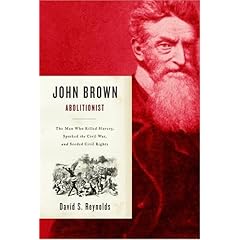
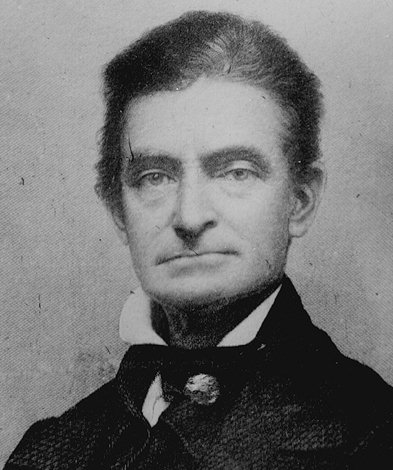
The Book Revue: John Brown, Abolitionist


A few weeks ago I finished David S. Reynolds' biography of one of the oddest figures of American history, John Brown. I am by no means an expert on John Brown, so I'm probably not qualified to make a substantive judgment of the book. I will say this, however, it is engagingly written for the most part, and seems to reflect a wealth of background knowledge on the subject. However, my biggest criticism is that it is not as well referenced as it should be. Reynolds uses endnotes, not footnotes, which makes is hard to see the source for a particular fact or assertion. Even worse, some facts are not referenced at all, leaving the reader to wonder if they are mere conjecture or if the author simply forget to source them. Despite this flaw, the book is well-written and paints a vivid (albeit perhaps a little too positive) picture of its subject.

One of the book's major contributions is the picture it paints of violence in ante-bellum frontier America and the South. I mentioned this in an older post. When we decry contemporary acts of savagery, we hardly remember bleeding Kansas.

With a name as common-sounding as Joe Smith, John Brown is a bundle of paradox and contradiction. On the one hand, he was religious in the extreme. A strict calvinist of the strictest conservative puritan mold, he refused to receive guests on the Sabbath. On the other hand, he was extremely progressive in his attitudes on race. Brown claimed that he did nothing more than take the Bible seriously, but in a time when even abolitionists believed as a matter of scientific fact in white supremacy, Brown believed in absolute equality. Despite his conservative religious attitudes, he was not exclusionary. His closest followers and confidants included religious men as well as atheists. He did not question their beliefs, only their commitment to kill slavery. He refused to entertain guests on the Sabbath, but his most violent campaigns took place on Sunday.

Understanding religion is key to understanding John Brown. Perhaps it is impossible to comprehend a man who felt called of God if one has not had spiritual experiences oneself. Unlike most other abolitionists, Brown felt that abolition was a heavenly mandate, not just a social good. This is probably the source of his urgency. He hated complacent abolitionists who did nothing but talk almost as much as he hated slaveholders. But faith can be dangerous as well. With a heavenly mandate, Brown felt that any means were justified to end slavery. Killingunarmed men and boys in the middle of night and hacking off their limbs was no crime to Brown. Dostoyevsky's Ivan Karamazov said that if there is no God, then everything is permitted. John Brown seems to suggest the opposite: that with God, (to paraphrase Gabriel) nothing is impossible, even murder is justified by those who believe that it is the will of God. I don't think that a belief in God itself leads one to commit violence, but people use their belief to justify the worst atrocities. Perhaps one of the lessons of John Brown is that faith is a two-edged sword.

But even so, John Brown shouldn't be dismissed as nothing more than a violent fanatic. In many ways, he was the first to take seriously what has become enshrined as the creed of our nation, that legal distinctions based on race are anathema to our national goodness. And he was the first to actually expect that this country would live up to the challenge. In fact, Brown was unique among abolitionists because he believed that the constitution was good. Most abolitionists, turned off by the 3/5 compromise and the guarantee that the slave trade would continue, called the constitution a "covenant with Hell." Brown on the other hand, believed that the constiution was essentially good, and that these flaws should be excised through the amendment process.

I grew up thinking that John Brown was insane to think that his small band of abolitionists could end slavery with an attack on Harper's Ferry. In reality, this is a vast oversimplification of his plan. His plan was not to kill slavery with one blow, but to strike at Harper's Ferry, commandeer the U.S. arsenal there, and flee into the Appalachians where he and his men would at random times conduct night-time raids, freeing slaves and bringing them back to their mountain hideout. Eventually, their small military camp would become a substantial racially integrated community. As this community grew larger, terrorized southerners would see the inevitable end of slavery and would give in to political pressure to end the "peculiar institution." What's more, Brown had historical precedent in Haiti to believe that such a plan would work.

Reynolds' denoument is too literary and too long. After telling an engaging story of Brown's life and death, Reynolds then engages in a survey of literature and popular songs that mention Brown, and attempts to draw a conclusion from all this. While this activity yields some interesting insights and historical trivia, it drags. Despite this, it is a good book. If only for the presentation of ante-bellum American violence, this book is worth reading.

Wednesday, June 6, 2007

In 1844, the democrats were split...


Bjorn recently left a comment on one of my old posts about Mitt Romney reminding us that "Romney wasn't the only Mormon candidate for president" and including an excerpt on Joseph Smith's political platform. (You can read Joseph Smith's platform unabridged, here. It is titled "Views on the Powers and Policy of the Government of the U.S.) Indeed Bjorn is right. Most recently, Utah's Senator Orrin Hatch (taking some time off from his bizarre music career, apparently) made an embarrassingly short-lived bid for president in 2000. Before that, Romney's own father put himself in the race for the republican nomination in 1968. A strong supporter of civil rights, Romney was a moderate republican, and as such was a bit of a dying breed. The general consensus is that his strong anti-war stance cost him the nomination. A Romney nomination (in 1964, that is) would have raised interesting constitutional questions because Romney was a U.S. citizen by birth, having been born to U.S. citizens living in Colonia Dublan, Chihuahua, Mexico. The fact that he was born outside of the U.S., some argued, made him a U.S. citizen, but not a "natural born citizen" as the constitution requires.

The excerpt Bjorn included comes from 1902 book written by William Linn called "The Story of the Mormons, From the Date of their Origin to the Year 1902. Though I have seen Linn's name mentioned in other Mormon history texts, I am unfamiliar with him and his work. Just cursorily skimming his preface I saw what seemed like a fairly unabashed anti-Mormon agenda with a moderate dose of sarcasm. But having not read the book, I am probably unqualified to make a an informed judgment. (You can read it, among other places, here.) My knowledge of Joseph Smith's candidacy comes mostly from Richard Bushman's and Donna Hill's work. Linn's final assessment of Joseph Smith's candidacy (in the part that Bjorn excerpted anyway) is that "there was nothing modest about Mormon political ambition."

It is this final comment that interests me. In some ways, he's absolutely right. Joseph Smith did have a vast amount of political clout in local politics and was a considerable force in state politics as well. While he always preserved the forms and the procedures of democracy, his concurrent positions in political and ecclesiastical leadership blurred the line for many people. The Nauvoo charter gave the city government considerable (though not unheard-of) independence from state government. Nauvoo itself was bigger than Chicago in its heyday. Fears of a Mormon bloc vote and the substantial political power of the Mormon community (along with dislike of the fact that most Mormons opposed slavery) were in large part what fueled anti-Mormon sentiment and politics years before in Missouri.

But on the other hand, Linn's comment makes it seem like Joseph Smith was not just a political force to be reckoned with, but that he was delusionally ambitious as well, which I'm not sure is accurate. It is true that when Joseph declared his candidacy, the whole church got involved. Missionaries became campaign canvassers, church papers took up the call, and amid the frenzy of hyperbole that characterized 19th-century politics, many Mormons probably believed that their prophet would actually win. Joseph himself postured and strutted in earnest like any candidate worth his salt. But did he actually think he had a chance of winning?

I don't think he did. That would have been so quixotic as to make Ralph Nader a paragon of pragmatism by comparison. Bare political ambition is too simplistic a motive. Early in the election, Joseph wrote each of the candidates then running asking what would be his policy toward the saints. The candidates essentially dismissed the question. Most notably, John Calhoun and Martin Van Buren cited concerns of federalism and state sovereignty to say that the "Mormon question" did not fall under federal jurisdiction. Joseph thought it was unreasonable that the President could call out the militia to suppress an insurrection at any time, but not to protect the lives and property of the citizens of a state unless requested by the governor. Unsatisfied, Joseph ran for president not because he expected to win, but to deprive unworthy candidates of the Mormon vote.

That's my take on it anyway. What do you think? Why did Joseph Smith run for president in 1844?

Wednesday, May 2, 2007

Whitney's "The Mormons": Reactions


After watching Parts 1 and 2 of Helen Whitney's documentary last night and the night before, I have a few observations. Overall, I thought it was well done and fair. I found myself frustrated at times that she wasn't telling the whole story. For example, the section on Polygamy presented the manifesto as something that was universally excepted by the whole church at that moment and ended polygamy in an instant. In reality, Mormon polygamy died a slow death. Even two Apostles, John W. Taylor, and Matthias F. Cowley were eventually excommunicated because of their refusal to abandon "the Principle." Greg Smith's FAIR article on post-manifesto polygamy gives a thorough and well-informed treatment. Though I'm not so sure about his conclusions, he tells the story well.

Giving the simplistic view, I think, cheapens the experience of Mormon polygamy and the inspiration of the manifesto. It is important to understand how much the pioneer saints had given and sacrificed for polygamy, and how long their leaders had preached it, to understand how hard it was to give up. Against this cultural background the courage and vision of the manifesto becomes clear. The simple view makes it seem like Wilford Woodruff was left with no choice and pressured into renouncing polygamy. In reality, the pioneer saints had "endured many things and hope[d] to be able to endure all things" to preserve what they believed was right. They would have gladly submitted to exile. It is too simple to say that the church dropped polygamy to get statehood. Polygamy was several orders of magnitude more important to men like John Taylor and Wilford Woodruff than was statehood.

Instead, a more holistic view takes the manifesto against that background as a visionary and progressive document. To essentially put aside 5 decades of church practice that had been tempered in the fires of Missouri and hardened through the plains and the deserts had to be more than mere capitulation to the federal government. Recognizing this, I think, recognizes the majesty and vision of the revelation behind the manifesto.

On the other hand, to tell the whole story would have been impossible in Whitney's medium. Polygamy would take the entire 4 hours. Her treatment was probably appropriate given the constraints.

Another criticism is that on a macro level, there was too much emphasis on the Mountain Meadows Massacre and on the September Six. These stories are important, but Whitney's states purpose was to give an outsider an insider's look at the Mormon experience. Many if not most Mormons know very little about the MMM and are not plagued by it. Whitney's devoting an entire 1/6 of Part 1 to the MMM made it seem like Mormons still have a guilt complex about it. I appreciated that Will Bagley's view was countered by Glen Leonard, but it would have been helpful to know that Bagley is on the fringe of the scholarly consensus on the MMM.

One last criticism: too much screen time given to Margaret Toscano and Tal Bachman. I've read most of Toscano's work. But her excommunication was not for her work and opinions as much as it was for her refusal to recognize that her own thoughts were not revelations to the entire church. She told the horror story of her church court but there was insufficient presentation of the other side. Part of that is the practical reality that disciplinary councils are confidential and the church does not publish those proceedings, so there really is only one side of the story out there. Whitney did acknowledge this, but it was brief. You could have easily missed it if you weren't paying attention. Bachman's remark that as a missionary he would have been willing to be a suicide bomber was inflammatory and totally unnecessary. It would have been helpful to counter that with a sane returned missionary. I was also annoyed by Bachman's insistence that he daily risked his life as a missionary. Sounds like a martyr complex to me.

Overall, though, I thought it was well done. The ending was great. I recommend it, but with the caveat that it is only a superficial treatment, a survey of sorts, and that only further reading will give you a more complete view. If "The Mormons" is the basis for all your knowledge of the Church of Jesus Christ of Latter-day Saints, your understanding will be superficial and lacking. But if you use "The Mormons" as a starting place for further reading, you will find it a great appetizer for a meatier meal.

What did you think?

Other resources:


Dave over at DMI has a nice list of the people interviewed with some info on each.

"The Mormons" website on pbs.org is a great resource with full transcripts of the interviews and more information.

The NYT gave it a positive review.

On Washingtonpost.com, Filmmaker Helen Whitney took part in a conversation with readers about the film. Her comments are worth reading.

Monday, April 30, 2007

Blood spilling and life taking

Last week, Warren posted a few observations on violence over at Salsa Night. The post is worth reading. The main point Warren makes is that modern society is less violent that older societies. He looks at examples of animal cruelty in entertainment (bear bating, cat burning) and some violent sports to demonstrate this idea.

I think Warren is right. Violence has been much more commonplace historically than now. But I don't think we need to look as far back as bear-bating to bear the argument out. (Incidentally, the companion sport to bear-bating was bull-bating, and the terms bear market and bull market actually derive from these sports because a bear would swipe down at a pack of hounds, while a bull would buck up to throw the dogs, but I digress.) Our own history, even fairly recent history is much more violent than most Americans probably know.

We all know the Civil War was bloody. But we are for the most part ignorant of the culture of violence that produced the Civil War and that was rampant throughout the South and on the frontier. Perhaps the most salient example is Bleeding Kansas. For about 5 or 6 years beginning in 1854, slave-state Missourians free-state settlers from the east clashed at the polls and on the field. The problems started with the compromise of 1854 which set aside the Missouri compromise and established that slavery in the territories of Kansas and Nebraska would be decided by the settlers rather than by the Senate. Kansans were mostly free-staters, so slavery-favoring politicians in Missouri incited mobs of Missourian "border ruffians" to cross over into Kansas, illegally vote at the point of the bowie knife, and take over the polls, blocking free-staters from voting. The Missourian plan worked, and a bogus pro-slavery government was established. The free-staters refused to recognize the illegally cast votes and established their own government. For a time, Kansas had two rival governments and armed militias on both sides regularly raided the seats of each. The federal government vacillated its support between the two Kansas legislatures.

During this time it was not uncommon for partisans of both groups to murder each other on the slightest provocation (or none at all) often cutting off limbs, hands, fingers, ears, slashing faces, and otherwise mutilating and defacing their dead enemies. Similar depredations had been experienced by Mormons at the hand of Missouri mobs a decade earlier. A Boston woman visiting Kansas in 1855 wrote home about the unprovoked murder of a local free-state man: "The border Missourians are a horseback people; always off somewhere; drink a great deal of whiskey, and are quite reckless of human life. . . .To shoot a man is not much more than to shoot a buck." (1) The unwritten code in the South was that "killing was all right if any prior threat had occurred. Sneak attack, attack from ambush, attack on the unarmed or even the sleeping, attack on one by several did little to detract from the honor of these public. . . murders." (2)

And these acts of violence were not limited to low-life border scum. Kentuckian Senator Henry Clay, the great compromiser, fought in two duels and his reputation remained intact. President Andrew Jackson once killed an opponent in a duel and assaulted another opponent with a gun and a knife. (3) In 1856, Charles Sumner was famously caned---savagely beaten with heavy gold head of a cane---by South Carolina Representative Preston Brooks because of a perceived insult to a distant relative. The family feud was common in the antebellum South (and though not common, survived even into the post-bellum South). According to Mark Twain's Buck Grangerford, "a feud is this way: a man has a quarrel with another man, and kills him; then that other man's brother kills him; then the other brothers, on both sides goes for one another; then the cousins chip in---and by and by everybody's killed off, and there ain't no more feud." (4) Sumner, attacked by surprise, was blinded by his own blood and became trapped under his desk. Brooks continued to beat Sumner until he ripped the desk out of the floor, staggered up the aisle and collapsed, unconscious. Brooks walked up the aisle and resumed beating the unconscious Sumner until he broke his cane and then quietly left the chamber. Sumner's blood was smeared around his desk and lay in a pool on the floor. (5)

Since we Americans are cursed with historical Amnesia, it helps to be reminded how recent the civil war really was. At the time of the First World War, the Civil War was as recent as the Second World War is to us. As late as 1932, a Civil War combat veteran was serving on the Supreme Court.

I think Warren is right that we commit as a society fewer acts of savage violence than earlier generations. However, I wonder at our entertainment. While it is true, as Warren points, out, that medieval societies enjoyed violence as entertainment, and that we could look farther back to Nero's treatment of Christians in the coliseum for even more gruesome examples, there isn't much in American history in the way of a public spectacle that people would pay to see that compares with, say, 300 or Gladiator. Even more disturbing is the fact that often our entertainment violence is participatory rather than just a spectator sport. The games we play put us in the position not of watching violence, but actually committing it in fantasy.

Another variable in the equation is today's increased capacity to inflict harm. The savageries of Bleeding Kansas saw men hack each other to death with sabers and bowie knives, but today one deranged man can kill scores before he is apprehended or takes his own life. It is this combination of fantasy violence and technological capacity to kill that makes contemporary American violence so disturbing.

Notes:
(1) Hannah Anderson Ropes, Six Months in Kansas, Boston: John P. Jewwtt, 1854., see ch. 4

(2) D. Grimsted, American Mobbing, Oxford U Press, 2003., pp. 91-92.

(3) D. S. Reynolds, John Brown, Abolitionist, NewYork: Knopf, 2005., p. 160.

(4) M. Twain, The Adventures of Huckleberry Finn, 1885, New York: Norton, 1977., p. 89.

(5) Reynolds, supra, p. 159.