Showing posts with label Visions. Show all posts

Tuesday, November 6, 2007

The best Joseph

Followers of Mormon film are aware of the difficulty of casting and playing the role of Joseph Smith, the prophet. It is somewhat similar to Richard Bushman's dilemma in writing a Joseph Smith biography. (See the preface to Rough Stone Rolling.) No matter what you do with the role, someone will be disappointed. The zealously faithful will complain that it wasn't laudatory enough. The cynics and skeptics will claim that it's too hagiographic. If you split the difference, everyone will complain that it is boring and stale.

Fortunately, the church has gotten better at casting the prophet's role over the years. I think it's safe to say that the recent (within the last two years or so) film is probably the best church-produced Joseph Smith picture and Nate did the best job of playing Joseph.

Part of the problem in playing Joseph Smith is that the man is a bundle of paradox. You have to be a mystic, but you have to be a down-to-earth Yankee and a frontier mayor. You have to be a visionary, but also a wrestler. You have to be a radical and also a man of power. It can seem schizophrenic. Mormons who play the prophet are even more keenly afflicted by the paradox, even if they are not conscious of it. The result can be paralyzing. Another problem is that for us Mormons, there is often so much emotion involved that you can easily get an over-the-top beyond Kenneth Branaugh-style portrayal---so emotionally charged that it borders on manipulative.

Non-LDS actors fare a bit better. Paradoxically, because they don't have the intimate personal experience with Joseph's legacy that Mormons do, they are not bound by the awful burden of trying to portray revelation---which no tongue can tell---on screen.

Oddly enough, my opinion is that the best Joseph Smith on the screen was Vincent Price in the 1940 picture Brigham Young. What I like about Price's acting is that he is otherworldly and mystic (this is Vincent Price, after all), but in a subtle and guileless, and natural way. He doesn't use overmuch emotion. He keeps it cool and collected, but not spookily so. He also portrays the friendship that Joseph had with his friends. Mormon Joseph's too often have had some kind of sacred distance between them and the rest of the cast that gets in the way. (Although more recently, this is better).

And a few years back there was the rumor that Richard Dutcher was going to bill Val Kilmer in his treatment of the prophet's life. Who knows how that would have gone. I'm inclined to think he'd do okay with it, but I think his performance would be more physical. I'm not convinced of his ability to really capture the charisma, though.

But if I could pick someone that would have played Joseph well but never did, I would have to pick Gene Wilder. Yes, yes, I know, that sounds absurd. But hear me out. Think of Charlie and the Chocolate Factory. Maybe this is just because when I was young I saw an awful portrayal of Joseph Smith in a very low-budget 1970s-era BYU student production. At the end of the film, a dead Josph Smith appears to Brigham Young in vision wearing, of all things, a purple tuxedo. Maybe it was this association between Joseph Smith and purple tuxedos that makes me think Gene Wilder would do a good job.

But think of Wilder's Willy Wonka. A man full of secrets, a man who loves children, values loyalty, a man who loves creativity. A visionary man who creates whole worlds in his factory. And think of Joseph Smith, a man who likewise revealed worlds, a man who loved to innovate, and who, like Willy Wonka, envisioned sending the fruits of his visions to bring joy to the whole world.

The chocolate factory itself (at least in the version Wilder appears in) is in some ways like the temple. You can't get in without a golden ticket (though, of course, the qualifications for getting one are just a little different from the temple recommend). Once inside you can't go anywhere unless directed. You are essentially taken on a journey by your guide through different worlds. There is a sin, some forbidden thing is taken, and it is only through admitting guilt and accepting responsibility that reconciliation with the creator can be achieved.

Yes, of course, that's a strained analogy. And yes, of course, I'm being half facetious. But when I say that Gene Wilder would have been a good Joseph Smith, I'm only half joking. I think he could have done it.

Tuesday, June 12, 2007

The Ancient of Days


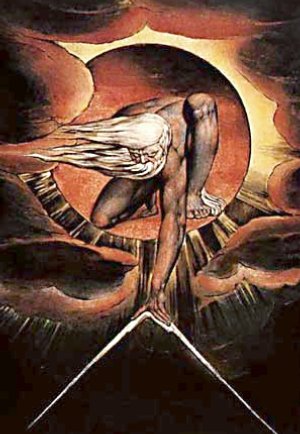
No, this post is not about Adam, pre-Adamites, or the origin of the Nodites. Nor is it about Mormonism except perhaps in a very tangential and attenuated way. I've been asked to explain the image in my profile. It is a painting by an English poet, painter, printer, engraver, and some say, prophet, William Blake. The painting is entitled "The Acnient of Days" and represents a creator figure, framing the earth with a compass.

Recognized as one of the "big six" canonical romantic poets (Blake, Coleridge, Wordsworth, Byron, Shelley, Keats), Blake is one of the most perplexing figures in Romanticism. He is a poet, like the others, but he is more than a poet because he often created his words with visual art that intertwines with its meaning. And he is more than an artist because he was also a creator of mythology. Volumes could be written (and have) about him, so I won't attempt to make a complete statement about the man.

I will say only that he was intensely religious, but hated the established church. He often had visions of heavenly visitors, beleived that he conversed with Old Testament prophets, and when he saw a sunset he claimed to behold "an innumerable company of the heavenly host crying, “Holy, holy, holy is the Lord God Almighty." He was also an intense beleiver in equality, humanity, charity, and love, often speaking against slavery and expounding on the wrongness of racism.

Many of his poems (I don't pretend to understand what are called his propetic books) appear deceptively simple. With a nursery-rhyme rhythm you might think you're reading kids stuff, but the themes are complex and sometimes dark, and he packs a lot of meaning into a few simple lines. Consider this indictment of London's booming prostitution industry at the turn of the century and its effect on young poor women:

O Rose, thou art sick!
The Invisible worm,
That flies in the night,
In the howling storm,

Has found out thy bed
Of Crimson joy;
And his dark secret love
Does thy life destroy.

Blake is one of my favorite writers. His art is also high on my list. One of his most underappreciated works is the set of illustrations he did for the book of Job. His visionary and mystical esctasies lead many to conclude that he was insane. For example, he once looked up and saw "God's head upon the window" and launched into a screaming fit. Indeed, as you read his life, it is hard to escape this conclusion. Even so, he ought not to be dismissed. Wordsworth said of him:

There was no doubt that this poor man was mad, but there is something in the madness of this man which interests me more than the sanity of Lord Byron and Walter Scott


Trivia:
1) What band got their name from a Blake writing?
2) Which U2 song is taken from a Blake poem?
3) Name one novelist and one additional artist who identify Blake as an influence.